
Menu
-
Shop All
Contact
hey@getstride.com
Stride Health Group
Stride Health Group Ltd
Company No 05158025
Lamas Road
Badersfield
Norwich
England
NR10 5FB
UK








Insulin resistance: signs, causes and how to test for it
Insulin resistance symptoms affect a significant proportion of adults in the UK, yet the condition is rarely identified before it has already shifted into pre-diabetes or type 2 diabetes territory. Insulin is the hormone that allows your cells to absorb glucose from the bloodstream for energy. In insulin resistance, cells stop responding efficiently to insulin's signal, so the pancreas compensates by producing more and more. Blood glucose can appear normal for years while insulin levels are quietly rising, creating a hidden metabolic pattern that progressively increases the risk of type 2 diabetes, heart disease, fatty liver disease, and PCOS. Understanding what is driving your metabolic health specifically requires looking at the biomarkers most commonly involved, and this is where targeted testing becomes useful.
What causes insulin resistance?
Excess visceral fat and abdominal adiposity
Visceral fat stored around the abdomen and organs is metabolically distinct from subcutaneous fat. It releases inflammatory cytokines and free fatty acids directly into the portal circulation, impairing the liver's ability to respond to insulin and suppressing insulin signalling in muscle cells. A waist circumference above 88cm in women or 102cm in men is associated with significantly elevated insulin resistance risk, independent of overall body weight. Waist measurement is more informative than BMI alone when assessing metabolic risk.
Sedentary behaviour and low muscle mass
Skeletal muscle is the primary site of glucose disposal in the body: when you eat, muscle cells absorb the majority of circulating glucose in response to insulin. People with low muscle mass or who are predominantly sedentary have reduced glucose disposal capacity, which means the pancreas must produce more insulin to achieve the same blood glucose clearance. Regular resistance training and aerobic exercise improve insulin sensitivity through multiple pathways, including increased GLUT4 transporter expression in muscle cell membranes.
High intake of refined carbohydrates and ultra-processed foods
Diets high in refined carbohydrates, added sugars, and ultra-processed foods produce rapid and large post-meal glucose spikes, requiring repeated high-insulin responses that over time desensitise cells to insulin's signal. Chronically elevated insulin levels also prevent fat breakdown between meals, which drives further fat storage and worsens the metabolic cycle. Fructose specifically, found in high concentrations in sugary drinks and fruit juice, is processed primarily by the liver and drives hepatic de novo lipogenesis and insulin resistance through a distinct pathway from glucose.
Poor sleep and circadian disruption
Sleep deprivation and irregular sleep timing impair insulin sensitivity, even in people who eat well and exercise regularly. A single night of poor sleep can reduce insulin sensitivity by up to 25 per cent in healthy adults. Chronic sleep restriction raises cortisol and growth hormone, both of which antagonise insulin action. Shift workers and people with irregular circadian patterns have significantly elevated rates of insulin resistance and type 2 diabetes compared to the general population, independent of diet and weight.
Chronic stress and elevated cortisol
Cortisol counteracts insulin by raising blood glucose and suppressing insulin signalling in peripheral tissues, a mechanism evolved for short-term stress but damaging when chronically activated. People with high psychological stress, high-pressure jobs, or ongoing financial or relational stressors show measurable insulin resistance even in the absence of other risk factors. The HPA axis (hypothalamic-pituitary-adrenal) and metabolic insulin signalling pathways are directly interconnected, meaning that addressing stress is not a peripheral wellness suggestion but a mechanistically important metabolic intervention.
Genetic predisposition
Some individuals are genetically predisposed to insulin resistance through variants in genes involved in glucose metabolism, adipogenesis, and insulin signalling. MTHFR variants can affect methylation and homocysteine metabolism in ways that compound metabolic risk. Certain ethnic groups, including South Asian, Black African, and Caribbean populations, develop insulin resistance at lower BMI thresholds than the general population, reflecting genetic differences in fat distribution, muscle composition, and metabolic rate.
PCOS and hormonal factors
Polycystic ovary syndrome (PCOS) and insulin resistance are closely connected: up to 70 per cent of women with PCOS have some degree of insulin resistance, even in the absence of excess weight. Insulin resistance in PCOS drives elevated androgen production by the ovaries, which worsens the hormonal and reproductive features of the condition. Managing insulin resistance through diet, exercise, and sometimes medication is central to PCOS treatment because the hormonal abnormalities frequently normalise as insulin sensitivity improves.
How to test for insulin resistance
Standard NHS testing for metabolic health typically includes HbA1c and sometimes fasting glucose. Both markers become elevated only once insulin resistance has progressed to pre-diabetes or diabetes stage, by which point insulin levels may have been elevated for five to ten years. This means that for a large proportion of adults with insulin resistance, routine testing returns a "normal" result despite a significant and ongoing metabolic problem.
A more sensitive approach assesses the markers that reflect insulin's function before glucose regulation breaks down:
HbA1c reflects average blood glucose over the preceding two to three months. It identifies pre-diabetes (42 to 47mmol/mol) and diabetes (48mmol/mol and above), but misses the earlier phase of insulin resistance where glucose is still normal.
Fasting glucose measures blood sugar after an overnight fast. As with HbA1c, it tends to rise only once the pancreas can no longer fully compensate for insulin resistance through increased insulin output.
Fasting insulin is the marker that identifies insulin resistance before glucose becomes affected. When cells resist insulin, the pancreas produces more to compensate: elevated fasting insulin alongside normal fasting glucose is the hallmark of early insulin resistance. This combination can be assessed using the HOMA-IR calculation (fasting glucose multiplied by fasting insulin, divided by a constant), developed by researchers at Oxford University. A HOMA-IR score below 1.0 indicates good insulin sensitivity. A score above 1.9 suggests early insulin resistance, and above 2.9 indicates significant insulin resistance.
Triglycerides and HDL cholesterol provide an indirect but accessible window into insulin resistance. High triglycerides combined with low HDL (the triglyceride-to-HDL ratio) is a recognised surrogate marker for insulin resistance used in cardiovascular research. This pattern reflects impaired lipoprotein metabolism driven by excess insulin and is visible in a standard lipid panel.
CRP (C-reactive protein) measures systemic inflammation, which both accompanies and compounds insulin resistance. Chronically elevated insulin promotes inflammatory cytokine release, and inflammation in turn worsens insulin signalling.
If your results suggest insulin resistance, a fasting insulin test can be added to calculate your HOMA-IR score with precision. This is most useful for people who want to track metabolic improvement over time as they make dietary, exercise, or lifestyle changes, since fasting insulin responds faster to intervention than HbA1c and identifies progress before glucose markers shift.
Evidence-based strategies to improve insulin sensitivity
Dietary carbohydrate quality and meal timing
Shifting from refined carbohydrates to whole foods with lower glycaemic impact is the most consistently evidence-supported dietary intervention for insulin resistance. This means replacing white bread, pasta, rice, sugary drinks, and ultra-processed snacks with whole grains, legumes, vegetables, and quality protein sources. Time-restricted eating (consuming all meals within an 8 to 10 hour window) has been shown in several controlled trials to improve fasting insulin and HOMA-IR independently of calorie reduction, primarily by extending the overnight fast and allowing insulin levels to remain low for longer periods.
Resistance training and movement
Muscle is the primary site of insulin-stimulated glucose uptake. Resistance training increases the number and activity of GLUT4 transporters in muscle cell membranes, improving glucose disposal independently of weight loss. Even two to three sessions of resistance training per week produce measurable improvements in insulin sensitivity within four to six weeks. Breaking prolonged sitting with short bouts of walking every 30 to 60 minutes also reduces postprandial glucose and insulin spikes in people who are predominantly desk-based.
Sleep quality and duration
Consistently achieving seven to nine hours of good-quality sleep is one of the most underestimated metabolic interventions. Addressing sleep apnoea, establishing consistent sleep and wake times, and reducing blue light exposure in the two hours before bed all have direct, measurable effects on fasting insulin and insulin sensitivity. Tracking biomarkers before and after addressing sleep issues often reveals larger metabolic improvements than dietary changes alone for people whose primary driver is sleep disruption.
Stress reduction and cortisol management
Interventions that reliably reduce cortisol output, including regular low-to-moderate intensity exercise, mindfulness practice, structured recovery time, and adequate sleep, all improve insulin sensitivity through the HPA-metabolic axis connection. The effect is dose-dependent and cumulative: the more consistently stress is managed, the more pronounced the improvement in insulin sensitivity over time. This is not a peripheral lifestyle recommendation but a mechanistically direct metabolic intervention for people in whom chronic stress is a primary driver.
Stride tests that can help with Insulin resistance
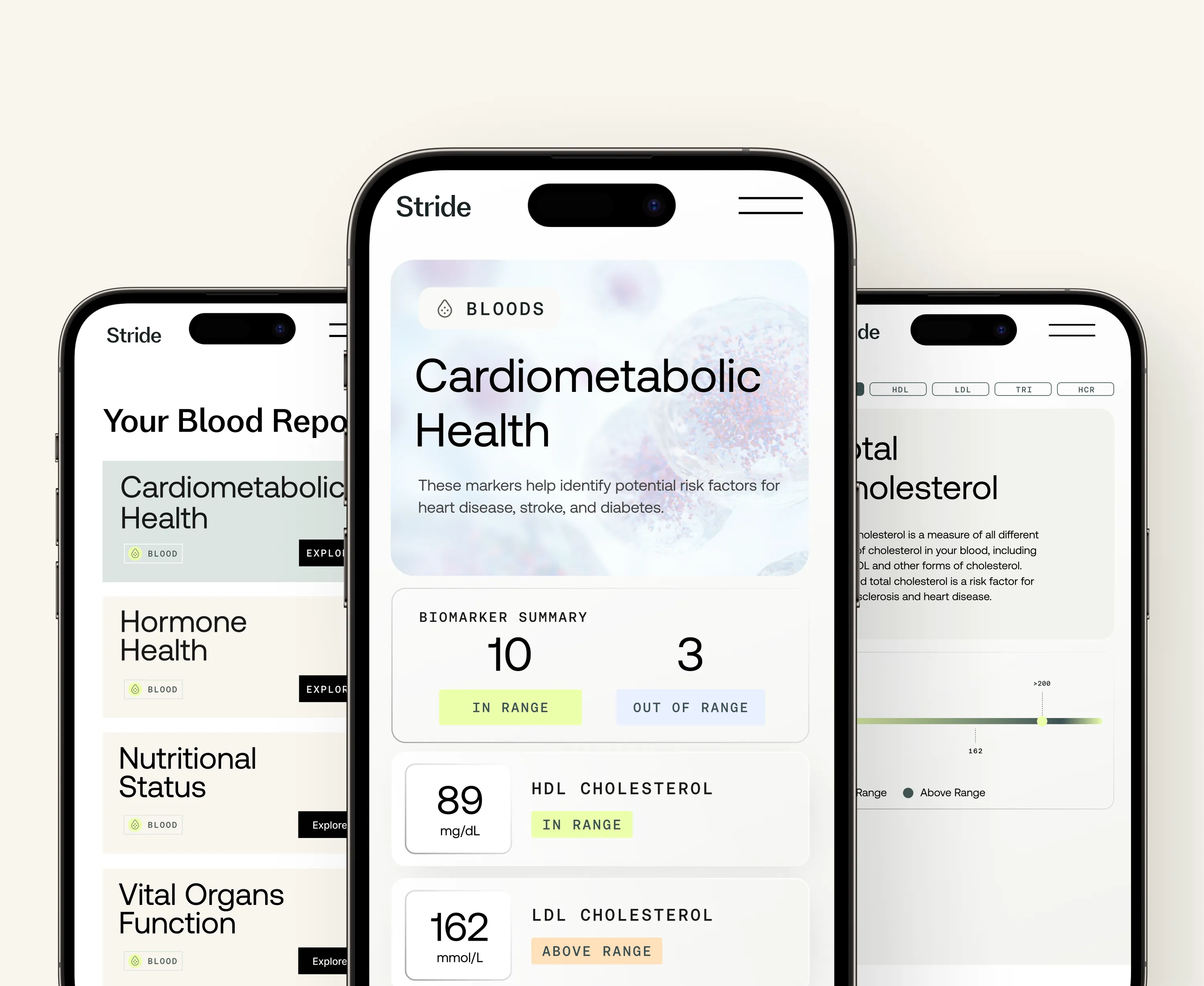
Health Tests
Optimal Bloods
At-home test for more than 70 blood-based biomarkers
From £399 £279.30
Biomarkers
| Biomarker | What it measures | Why it matters | Relevance |
|---|---|---|---|
| HbA1c Blood Test (Glycated Haemoglobin) | Average blood glucose over 3 months | Identifies pre-diabetes and diabetes; normal HbA1c does not rule out early insulin resistance | 4 |
| Glucose Blood Test | Blood sugar after overnight fast | Rises later than insulin; normal fasting glucose does not rule out compensated insulin resistance | 4 |
| Triglycerides Blood Test (Heart Health & Metabolic Biomarker) | Circulating blood fat | Elevated triglycerides are a hallmark of insulin resistance; impaired insulin action drives hepatic overproduction | 5 |
| HDL Cholesterol Blood Test | "Good" cholesterol | Low HDL combined with high triglycerides is one of the most sensitive indirect markers of insulin resistance | 5 |
| hsCRP Blood Test (High Sensitivity C-Reactive Protein) | Systemic inflammation | Chronic inflammation accompanies and worsens insulin resistance; elevated CRP in the context of normal glucose is a warning sign | 4 |
| LDL Cholesterol Blood Test | "Bad" cholesterol | Insulin resistance drives production of small dense LDL particles, which are more atherogenic than standard LDL | 3 |
| ApoB Blood Test (Apolipoprotein B) | Total atherogenic lipoprotein particle count | Captures cardiovascular risk from small dense LDL more accurately than standard LDL in people with insulin resistance | 4 |
| TSH Blood Test (Thyroid Stimulating Hormone) | Thyroid stimulating hormone | Hypothyroidism independently worsens insulin sensitivity and can mimic or compound insulin resistance | 3 |
| Vitamin D Blood Test (25-OH) | 25-OH vitamin D status | Vitamin D deficiency is associated with impaired insulin secretion and increased insulin resistance risk | 3 |
FAQs
What are the early signs and symptoms of insulin resistance?
Insulin resistance often has no noticeable symptoms in its early stages, which is why it can go undetected for years. When symptoms are present they often include: difficulty losing weight despite dietary changes, particularly around the abdomen; persistent fatigue after meals; intense sugar cravings, especially in the afternoon; brain fog following carbohydrate-heavy meals; skin tags on the neck or armpits; and dark, velvety patches of skin called acanthosis nigricans, typically on the neck, groin, or underarm. Women with PCOS may also experience irregular periods, acne, or excess hair growth driven by the androgen excess that insulin resistance triggers in the ovaries.
Can you have insulin resistance with normal blood sugar?
Yes, this is the central challenge with standard metabolic screening. Insulin resistance typically develops five to ten years before blood glucose rises out of the normal range. During this period, the pancreas compensates by producing increasing amounts of insulin to maintain glucose control. A person can have significantly elevated fasting insulin and substantial HOMA-IR scores while their HbA1c and fasting glucose remain entirely within the normal reference range. Standard NHS testing does not routinely measure fasting insulin, which is why the condition is so commonly missed until it has already progressed to pre-diabetes or diabetes.
What is the HOMA-IR test and what does it measure?
HOMA-IR (Homeostatic Model Assessment of Insulin Resistance) is a mathematical calculation developed by researchers at Oxford University that estimates insulin resistance using two simple fasting blood measurements: fasting glucose and fasting insulin. The formula multiplies these two values and divides by a constant (22.5 when using SI units). A score below 1.0 indicates good insulin sensitivity. A score above 1.9 suggests early insulin resistance, and above 2.9 indicates significant insulin resistance. The advantage of HOMA-IR is that it can identify insulin resistance long before glucose markers become abnormal, giving time to reverse the pattern through lifestyle changes before it progresses to pre-diabetes or type 2 diabetes.
Is insulin resistance the same as pre-diabetes?
They are related but distinct. Insulin resistance is a physiological state in which cells respond suboptimally to insulin. Pre-diabetes is a clinical diagnosis defined by HbA1c between 42 and 47mmol/mol or fasting glucose between 6.1 and 6.9mmol/L, indicating that glucose regulation is beginning to fail. Most people with pre-diabetes have underlying insulin resistance, but many people with insulin resistance have not yet reached the glucose thresholds that define pre-diabetes. This distinction matters because insulin resistance is more reversible the earlier it is identified and addressed, before the beta cells of the pancreas have been under sustained strain for years.
How does insulin resistance cause weight gain?
Elevated insulin levels have a direct fat-storage effect: insulin is the primary signal for adipose tissue to store fat and the primary inhibitor of fat breakdown (lipolysis). When insulin is chronically elevated due to insulin resistance and compensatory hyperinsulinaemia, the body is in an almost continuous fat-storage state and finds it very difficult to access stored fat for energy between meals. This creates a pattern where calorie restriction produces fatigue and hunger before meaningful fat loss, because the metabolic environment is biased toward storage rather than mobilisation. Addressing insulin resistance directly (through dietary changes, exercise, and sleep) shifts this metabolic balance and often makes weight management considerably more tractable.
Can insulin resistance be reversed?
Yes, particularly when identified early. Insulin resistance is driven by modifiable lifestyle factors in the majority of cases, and the evidence base for reversibility is strong. Sustained dietary changes (reducing refined carbohydrates, increasing fibre and protein), regular exercise (particularly resistance training), improved sleep quality, and effective stress management all improve insulin sensitivity through distinct but complementary mechanisms. In clinical studies, significant improvements in HOMA-IR and fasting insulin are visible within four to twelve weeks of consistent lifestyle intervention. Tracking biomarkers over time is the most reliable way to confirm that the changes you are making are actually producing metabolic improvement for your biology specifically.
What is the link between insulin resistance and PCOS?
Insulin resistance is found in up to 70 per cent of women with PCOS, regardless of body weight. The mechanism is bidirectional: insulin resistance drives the ovaries to produce excess androgens (testosterone, DHEA-S), which disrupts ovulation and causes many of the features associated with PCOS (irregular periods, acne, excess hair growth). Elevated androgens in turn worsen insulin resistance. This cycle means that addressing insulin resistance is mechanistically central to managing PCOS, not just a general healthy living recommendation. Many of the hormonal abnormalities associated with PCOS improve significantly as insulin sensitivity is restored through dietary changes, exercise, and in some cases medication such as metformin.
How is insulin resistance connected to heart disease?
Insulin resistance drives cardiovascular risk through multiple converging pathways: it raises triglycerides and lowers HDL, promotes the production of small dense atherogenic LDL particles, raises blood pressure, increases systemic inflammation (CRP), and promotes endothelial dysfunction in blood vessels. People with insulin resistance have significantly elevated rates of cardiovascular events independent of whether they develop type 2 diabetes. The cardiometabolic risk associated with insulin resistance is therefore not confined to diabetes prevention but applies to the entire cardiovascular system. This is why assessing the full lipid picture, CRP, and HbA1c together provides a more complete cardiovascular risk assessment than standard cholesterol testing alone.
Does metformin help with insulin resistance even without diabetes?
Metformin, a medication primarily prescribed for type 2 diabetes, improves insulin sensitivity by reducing the liver's glucose output and improving cellular insulin response, particularly in muscle tissue. It is sometimes prescribed off-label for people with significant insulin resistance or pre-diabetes, and is widely used in PCOS management regardless of blood glucose levels because of its direct effect on androgen production mediated through insulin. Whether metformin is appropriate for an individual without diabetes is a decision to make with a GP or endocrinologist, based on the full clinical picture including HOMA-IR, HbA1c, and cardiovascular risk factors. Lifestyle interventions can achieve similar improvements in insulin sensitivity without medication in many people when implemented consistently.
Find out what your body is actually trying to tell you.
Answer 8 quick questions and get a free personalised report - covering which area of your biology is most worth looking at first, what testing in that area reveals, and what actions become available once you have that data.
Where do you feel you're operating below your potential right now?
Methylation & Cellular Health
Your biology is signalling a methylation upgrade - here’s what that means and what to do about it.