
Menu
-
Shop All
Contact
hey@getstride.com
Stride Health Group
Stride Health Group Ltd
Company No 05158025
Lamas Road
Badersfield
Norwich
England
NR10 5FB
UK










Perimenopause symptoms: what's changing and how to check your hormones
Perimenopause is the transitional phase leading up to menopause, during which the ovaries gradually reduce their output of oestrogen and progesterone. It typically begins in the mid-40s, though it can start earlier, and lasts an average of four to eight years before periods stop entirely. The defining challenge is that its symptoms are varied, often dismissed, and easy to attribute to other causes: stress, poor sleep, depression, thyroid problems, or simply getting older. Understanding what is actually changing hormonally — and which biomarkers are worth checking alongside the reproductive hormones — is where testing becomes useful, not just for confirmation but for ruling out the conditions that most closely mimic perimenopause.
What causes perimenopause symptoms?
Declining and fluctuating oestrogen levels
The central driver of perimenopause is a gradual decline in oestrogen (specifically oestradiol), produced as the ovaries become less responsive to the pituitary's signalling hormones. What makes perimenopause particularly confusing is that oestrogen does not fall in a smooth, linear way — it fluctuates dramatically, sometimes spiking higher than premenopausal levels before dropping. This erratic pattern means that a single blood test taken on any given day may show oestradiol in a normal or even elevated range, even in someone who is clearly perimenopausal. The fluctuation itself is what produces many of the symptoms: hot flushes, night sweats, and mood instability are often triggered by the rate of oestrogen change rather than absolute levels.
Rising FSH as the brain tries to compensate
As the ovaries become less responsive, the pituitary gland increases its output of follicle-stimulating hormone (FSH) in an attempt to stimulate egg development. Consistently elevated FSH — particularly above 25 IU/L — can suggest that the ovaries are losing their responsiveness. However, FSH levels fluctuate significantly in perimenopause and a single normal result does not exclude perimenopause. For women under 40 experiencing possible perimenopause symptoms, two elevated FSH results taken four to six weeks apart are used to support a diagnosis of premature ovarian insufficiency (POI).
Declining progesterone and cycle changes
Progesterone, produced in the second half of the menstrual cycle after ovulation, is often the first hormone to fall in early perimenopause. As ovulation becomes less consistent, progesterone output in the luteal phase declines, leading to shorter cycles, heavier or irregular periods, more pronounced PMS, and worsening sleep quality. Progesterone also has an anxiolytic (anxiety-reducing) effect via its conversion to allopregnanolone, which acts on GABA receptors. Declining progesterone can therefore contribute directly to increased anxiety, poor sleep, and mood changes — often before oestrogen levels have shifted significantly.
The thyroid-perimenopause overlap
Thyroid conditions become more common in women during their 40s and produce symptoms that closely mirror perimenopause: fatigue, weight changes, mood shifts, difficulty sleeping, brain fog, and altered periods. An underactive thyroid slows these processes; an overactive thyroid accelerates them. Distinguishing between thyroid dysfunction and perimenopause — or identifying that both are present at once — requires testing both sets of markers. Thyroid function should always be assessed alongside reproductive hormones in any perimenopausal investigation.
Testosterone decline and its effects
Testosterone is produced in the ovaries and adrenal glands throughout a woman's life and declines gradually from the mid-30s onwards. Low testosterone in women is associated with reduced libido, loss of motivation, difficulty concentrating, and a general reduction in energy and drive that is distinct from the fatigue caused by oestrogen changes. In perimenopause, declining testosterone can compound the effects of falling oestrogen — but it is rarely tested as part of a standard NHS assessment.
Brain fog, memory, and the cognitive effects of hormonal change
Cognitive symptoms are among the most distressing and least validated aspects of perimenopause. Many women experience difficulty with word retrieval, concentration, and short-term memory during perimenopause, and find these dismissed as anxiety or early dementia. The relationship between oestrogen and cognitive function is well-established: oestradiol supports neuronal health, blood flow to the brain, and the function of neurotransmitter systems including serotonin and dopamine. The fluctuating oestrogen of perimenopause disrupts these systems, producing real cognitive symptoms that typically improve as oestrogen stabilises — either naturally at menopause or with HRT.
How to test for perimenopause
The British Menopause Society's position is that a blood test is not required to diagnose perimenopause in women aged 45-55 who have typical symptoms — in this age group, the diagnosis is primarily clinical. However, testing is valuable for several important reasons: to rule out conditions that mimic perimenopause (especially thyroid disorders and anaemia), to investigate symptoms in women under 45 where the picture is less clear, and to establish a baseline of metabolic and hormonal markers before any treatment decisions are made.
FSH (follicle-stimulating hormone) rises as the ovaries become less responsive. A consistently elevated FSH supports a perimenopausal or menopausal picture. However, because FSH fluctuates so significantly during perimenopause, a single result — even a normal one — does not rule it out.
Oestradiol reflects the level of the most bioactive oestrogen at the moment the blood was taken. Because it fluctuates dramatically throughout the perimenopausal transition, a single measurement is of limited value in confirming or denying perimenopause. It is most useful when monitoring HRT absorption once treatment is established.
TSH and Free T4 assess thyroid function. Thyroid conditions that closely mimic perimenopausal symptoms are common in this age group and should be tested in any perimenopausal investigation, even if symptoms appear straightforwardly hormonal.
Ferritin and a full blood count assess whether iron deficiency anaemia — a very common cause of fatigue, brain fog, and low mood, particularly in women with heavier periods — is contributing to symptoms. Heavy or irregular bleeding during perimenopause frequently causes iron depletion.
Vitamin D should be checked as part of any midlife health assessment. Oestrogen supports vitamin D metabolism and its protective effects on bone. As oestrogen falls, ensuring vitamin D is optimal becomes more important for bone density, immune function, and mood.
Cholesterol and lipid markers change significantly around perimenopause: oestrogen has a cardioprotective effect on lipid profiles, and as it falls, LDL cholesterol typically rises and HDL tends to fall. Establishing a lipid baseline in the perimenopausal transition is important context for long-term cardiovascular health monitoring.
For women who need reproductive hormone testing specifically — FSH, LH, and oestradiol — this is available through your GP or private clinics. Note that for women with regular periods, reproductive hormones should ideally be tested on days 2-5 of the cycle for the most interpretable results. For women with irregular periods, testing at any time alongside repeat measurements gives a more reliable picture.
Evidence-based strategies to support the perimenopause transition
Nutrition and bone protection before oestrogen falls further
Oestrogen has a direct protective effect on bone density. As oestrogen declines in perimenopause, bone loss accelerates — typically at its fastest rate in the two to three years around the final period. Ensuring adequate calcium (through dairy, fortified plant milks, tinned fish with bones, and leafy greens) and optimal vitamin D (through sun exposure, diet, and supplementation where needed) provides the nutritional foundation for bone maintenance. Tracking vitamin D specifically gives you the data to know whether you're in the range that actually supports bone protection, rather than guessing.
Exercise as metabolic and bone protection
Weight-bearing exercise — walking, running, dancing, resistance training — is among the most well-evidenced interventions for maintaining bone density during perimenopause. Resistance training in particular supports both bone and muscle mass, countering the simultaneous loss of both that occurs as oestrogen falls. Regular physical activity also improves sleep quality, cardiovascular metabolic markers, and mood — all domains affected by the perimenopause transition.
Sleep, cortisol, and the hormonal cascade
Poor sleep during perimenopause is often driven by night sweats (linked to oestrogen fluctuation) but is amplified by elevated cortisol from disrupted sleep itself — creating a cycle where poor sleep raises cortisol, which further disrupts sleep architecture. Managing sleep hygiene, reducing late-day stimulants, and establishing consistent sleep timing help interrupt this cycle. Tracking inflammatory markers (CRP) and metabolic markers (HbA1c) over time shows whether sleep disruption is leaving measurable traces in the biology.
Gut health and oestrogen recirculation
The gut microbiome plays a role in oestrogen metabolism via a collection of bacteria collectively called the estrobolome, which produce enzymes that deconjugate oestrogen, allowing it to be reabsorbed rather than excreted. A disrupted microbiome can impair this process, reducing the body's effective oestrogen activity. This connection between gut health and hormonal balance is an emerging area of research — and one reason why gut health becomes increasingly relevant as a modifiable factor during perimenopause.
Stride tests that can help with Perimenopause symptoms
Health Tests
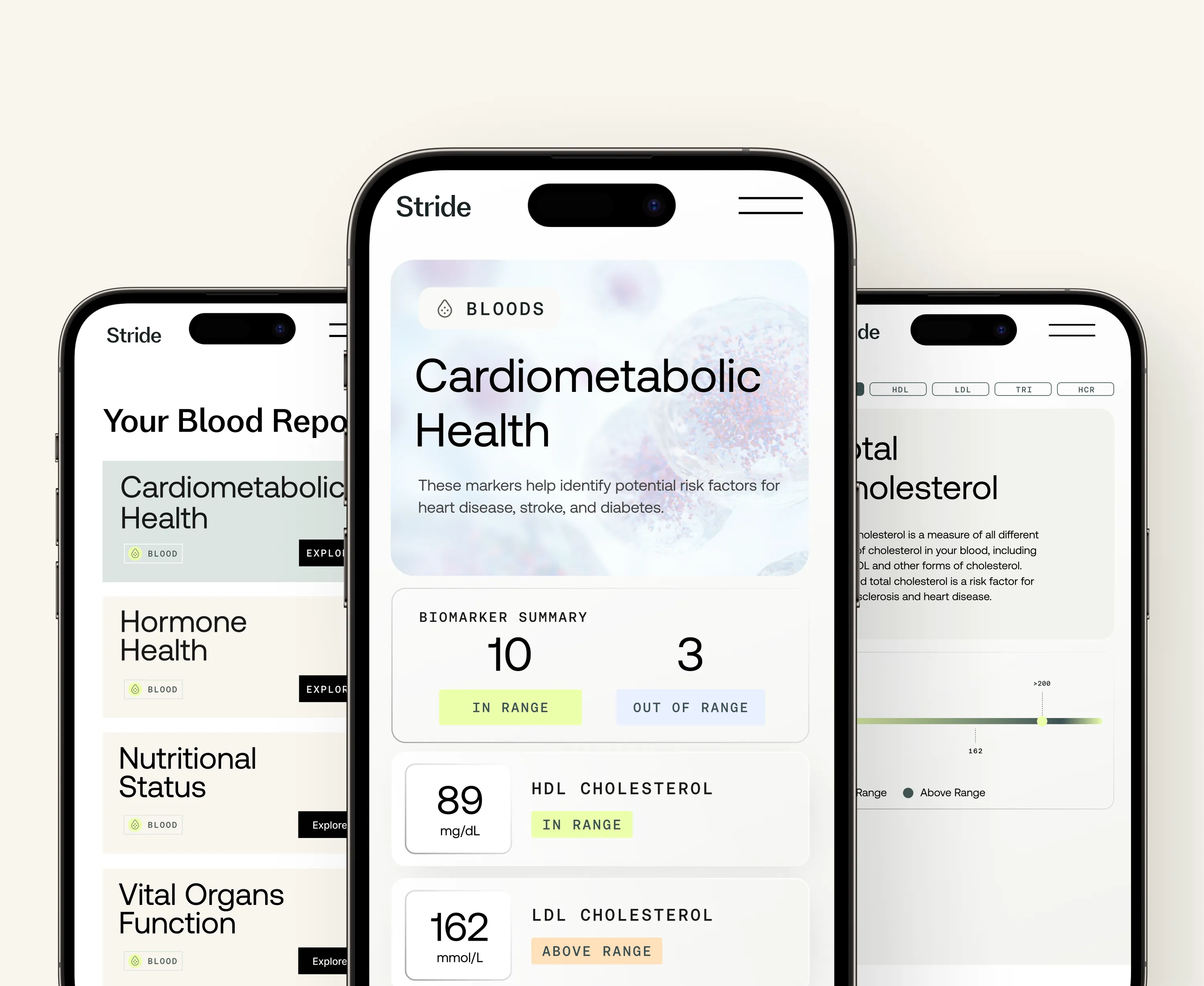
Optimal Bloods
At-home test for more than 70 blood-based biomarkers
From £399 £279.30
Biomarkers
| Biomarker | What it measures | Why it matters | Relevance |
|---|---|---|---|
| TSH Blood Test (Thyroid Stimulating Hormone) | Thyroid function | Thyroid conditions closely mimic and co-occur with perimenopause; essential to test | 5 |
| Ferritin Blood Test | Iron storage | Heavy perimenopausal periods cause iron depletion; contributes to fatigue and brain fog | 5 |
| Vitamin D Blood Test (25-OH) | 25-OH vitamin D status | Bone protection; immune function; mood — all become more important as oestrogen falls | 5 |
| LDL Cholesterol Blood Test | Low-density lipoprotein | Rises as oestrogen falls; establishing a baseline is important for cardiovascular monitoring | 4 |
| FT4 (Free Thyroxine) Blood Test | Thyroid hormone output | Assessed alongside TSH to confirm thyroid function | 4 |
| Active B12 Blood Test (Holotranscobalamin) | Active B12 status | Contributes to brain fog and fatigue; often depleted in midlife | 3 |
| hsCRP Blood Test (High Sensitivity C-Reactive Protein) | Systemic inflammation | Oestrogen decline increases baseline inflammatory activity; worth monitoring | 3 |
| HbA1c Blood Test (Glycated Haemoglobin) | Average blood glucose | Insulin sensitivity declines in perimenopause; a key metabolic marker to track | 3 |
| Triglycerides Blood Test (Heart Health & Metabolic Biomarker) | Blood fat levels | Metabolic risk increases through perimenopause; part of cardiovascular baseline | 2 |
FAQs
How do I know if I am in perimenopause?
Perimenopause is primarily a clinical diagnosis based on age and symptoms rather than a definitive blood test. For women aged 45-55, the combination of changing periods (shorter cycles, heavier bleeding, or increasing irregularity) alongside other symptoms — hot flushes, night sweats, sleep disruption, mood changes, brain fog, or reduced libido — is typically sufficient to make the diagnosis without blood tests. The key symptoms of perimenopause develop gradually and often begin years before periods stop. If you are under 45 and experiencing these changes, testing reproductive hormones (FSH, LH, oestradiol) and thyroid function is more important, as other conditions need to be ruled out and the possibility of premature ovarian insufficiency should be assessed.
What blood test can confirm perimenopause?
No single blood test definitively confirms perimenopause. FSH (follicle-stimulating hormone) is the most commonly used marker — a consistently elevated FSH (typically above 25 IU/L on two separate occasions) suggests the ovaries are losing their responsiveness, which supports a perimenopausal or menopausal picture. However, because FSH fluctuates so significantly during perimenopause — it can be low on one test and high on another, even in the same month — a single result is unreliable. For women under 40 specifically, two elevated FSH results taken four to six weeks apart are used to investigate premature ovarian insufficiency. The British Menopause Society recommends that in women aged 45 and above, perimenopause can be diagnosed on symptoms alone, without blood tests.
What are the earliest symptoms of perimenopause?
The earliest perimenopausal symptoms often involve cycle changes rather than the hot flushes and night sweats most commonly associated with the transition. Cycles typically shorten first — periods that reliably arrived every 28-30 days may begin arriving every 24-25 days. PMS symptoms may worsen, particularly in the week before a period. Sleep quality often declines before other symptoms emerge, driven by falling progesterone rather than oestrogen. Mood changes — increased irritability, low mood, or anxiety that feels disproportionate — are also among the earlier presentations. Some women notice reduced libido and a generalised change in energy and motivation years before periods become irregular.
Can perimenopause cause anxiety and mood changes?
Yes. Anxiety and mood instability are among the most common and least recognised perimenopause symptoms, and they can appear before any physical signs of hormonal change. Progesterone, which declines early in perimenopause, has an anxiolytic effect via its conversion to allopregnanolone — a neurosteroid that activates GABA receptors (the brain's primary calming system). As progesterone falls, this natural anxiolytic effect diminishes. Oestrogen fluctuations further affect serotonin, dopamine, and noradrenaline — the neurotransmitters most closely linked to mood regulation. The result is that many women experience new or worsening anxiety, increased emotional sensitivity, or depression during perimenopause that responds better to HRT than to antidepressants alone, particularly when the hormonal context is recognised. Checking thyroid function, vitamin D, and ferritin alongside recognising the hormonal picture rules out other treatable contributors.
Is it normal to have brain fog during perimenopause?
Brain fog — difficulty concentrating, memory lapses, word-finding problems, and mental cloudiness — is one of the most commonly reported and most distressing perimenopausal symptoms. It affects the majority of women in perimenopause to some degree. The mechanism involves oestrogen's role in supporting cerebral blood flow, neuronal health, and the function of neurotransmitter systems. As oestradiol fluctuates and falls, these processes are disrupted. Cognitive symptoms typically worsen during the perimenopause transition and often improve substantially once oestrogen stabilises, whether naturally or with HRT. Ruling out other contributors — low ferritin, vitamin B12 deficiency, thyroid dysfunction, and vitamin D deficiency — all of which cause cognitive symptoms independently — is important before attributing brain fog solely to hormonal change.
How is perimenopause different from menopause?
Perimenopause is the transitional phase leading to menopause, characterised by fluctuating hormones, changing periods, and variable symptoms. Menopause itself is a specific moment — defined as 12 consecutive months without a period — after which a woman is described as postmenopausal. Perimenopause can last four to eight years, during which symptoms may come and go in intensity as hormones fluctuate. Once menopause is reached, oestrogen levels stabilise at a consistently lower level, and the unpredictability of the perimenopausal fluctuations typically reduces — though symptoms like hot flushes and sleep disruption can continue for years into postmenopause.
At what age does perimenopause usually start?
The average age for perimenopause to begin is the mid-to-late 40s, typically between 45 and 50, though a meaningful number of women notice changes in their early 40s. The average age of menopause in the UK is 51. Women who reach menopause before the age of 45 are described as having early menopause; before age 40 is classified as premature ovarian insufficiency (POI), which affects approximately 1% of women and warrants specific investigation and management. Smoking is associated with earlier menopause by an average of one to two years. Family history is the strongest predictor of when you are likely to transition — if your mother or older sisters experienced early perimenopause, you are more likely to as well.
Can perimenopause affect weight and metabolism?
Yes. Weight gain during perimenopause — particularly around the abdomen — is common and driven by several intersecting changes: declining oestrogen alters fat distribution patterns (shifting from a gynoid to a more central pattern), declining muscle mass reduces basal metabolic rate, insulin sensitivity decreases, and sleep disruption disrupts appetite-regulating hormones. The result is that the same diet and activity level that maintained weight in earlier adulthood may lead to gradual weight gain. Monitoring HbA1c and fasting lipids provides an objective measure of whether metabolic changes are occurring, and gives a data point to track how lifestyle interventions are working. Testing rather than guessing means interventions can be targeted to your specific biology.
Find out what your body is actually trying to tell you.
Answer 8 quick questions and get a free personalised report - covering which area of your biology is most worth looking at first, what testing in that area reveals, and what actions become available once you have that data.
Where do you feel you're operating below your potential right now?
Methylation & Cellular Health
Your biology is signalling a methylation upgrade - here’s what that means and what to do about it.