
Menu
-
Shop All
Contact
hey@getstride.com
Stride Health Group
Stride Health Group Ltd
Company No 05158025
Lamas Road
Badersfield
Norwich
England
NR10 5FB
UK








Overactive thyroid: symptoms, causes and how to test for hyperthyroidism
Overactive thyroid — clinically called hyperthyroidism — is a condition where the thyroid gland produces more thyroid hormone than the body needs, accelerating metabolic processes across multiple systems. It affects roughly 1-2% of women and 0.2% of men in the UK at some point in their lives, and is significantly more common in women aged 20 to 50. The challenge is that its symptoms — anxiety, weight changes, heart palpitations, and sleep disturbance — mimic many other conditions, and develop gradually enough to be attributed to stress or lifestyle rather than a thyroid problem. A simple blood test measuring TSH, Free T4, and Free T3 is usually sufficient to confirm or rule out an overactive thyroid, and understanding what your results actually mean is where the picture becomes more nuanced.
What causes an overactive thyroid?
Graves' disease (the most common cause)
Graves' disease accounts for approximately 75% of hyperthyroidism cases. It is an autoimmune condition in which the immune system produces antibodies — specifically TSH-receptor antibodies (TRAb) — that mimic the pituitary's signal to the thyroid. Rather than stimulating hormone production in the normal controlled way, these antibodies keep the thyroid continuously activated, causing it to overproduce thyroxine (T4) and triiodothyronine (T3). Graves' disease runs in families and is more likely in people who already have other autoimmune conditions. It can also cause thyroid eye disease (Graves' ophthalmopathy), in which inflammation around the eye muscles causes the eyes to appear prominent or bulging — affecting around a quarter of people with Graves' disease.
Toxic thyroid nodules
Nodules — lumps of thyroid tissue — can sometimes develop the ability to produce thyroid hormone independently, without needing TSH stimulation from the pituitary. A single autonomous nodule is called a toxic adenoma; multiple nodules producing excess hormone together is called toxic multinodular goitre. This pattern is more common in people over 60 and in regions with low dietary iodine intake. The mechanism is different from Graves' disease — it is a structural issue rather than an autoimmune one — and this affects which treatment approach is most appropriate.
Thyroiditis (inflammation of the thyroid)
Thyroiditis occurs when the thyroid gland becomes inflamed, causing stored thyroid hormone to leak into the bloodstream. This produces a temporary period of hyperthyroidism that typically resolves on its own, sometimes followed by a period of hypothyroidism as the gland recovers. Causes include viral infections (subacute thyroiditis), autoimmune activity (Hashimoto's thyroiditis can cause a transient hyperthyroid phase), and postpartum thyroiditis — which affects around 5-10% of women in the year following childbirth.
Excess iodine
Iodine is the raw material for thyroid hormone production. Consuming excess iodine — through iodine-rich supplements, kelp, or certain medications including amiodarone (used for heart arrhythmias) — can trigger overproduction in some people, particularly those with underlying nodular thyroid disease. Iodine-containing contrast agents used in medical imaging are another potential trigger.
Subclinical hyperthyroidism
In subclinical hyperthyroidism, TSH is suppressed below the normal range, but Free T4 and Free T3 remain within normal limits. Symptoms may be absent or mild. While it often resolves spontaneously, subclinical hyperthyroidism in older adults — particularly those with TSH below 0.1 mIU/L — carries meaningful risk of atrial fibrillation and bone density loss, and warrants monitoring or treatment depending on clinical context.
How to test for an overactive thyroid
Thyroid function testing is the essential first step for anyone with symptoms suggesting hyperthyroidism. The standard NHS thyroid function test measures TSH — and in an overactive thyroid, TSH is typically low or undetectable, because high circulating thyroid hormones suppress the pituitary's signalling. When TSH is low, Free T4 is usually added in a second step to assess whether thyroid hormones themselves are elevated.
Understanding the full thyroid picture — not just TSH — is important for several reasons.
TSH measures the pituitary's signal to the thyroid. In hyperthyroidism, TSH is suppressed, often to very low or undetectable levels. A normal TSH makes an overactive thyroid unlikely. A low TSH requires follow-up testing to establish whether thyroid hormones are elevated and, if so, to identify the cause.
Free T4 is the circulating storage form of thyroid hormone. Elevated Free T4 alongside a suppressed TSH confirms overt hyperthyroidism. In subclinical hyperthyroidism, Free T4 remains within range despite a suppressed TSH.
Free T3 is the metabolically active form of thyroid hormone. In some forms of hyperthyroidism, particularly early Graves' disease, Free T3 rises before Free T4 becomes elevated — meaning a panel that includes only TSH and Free T4 may miss the diagnosis at an early stage. Measuring Free T3 alongside TSH and Free T4 gives a more complete picture of thyroid hormone activity.
TRAb (TSH-receptor antibodies) are the specific antibodies that cause Graves' disease. A positive TRAb result confirms Graves' disease as the cause of hyperthyroidism, which informs treatment decisions, prognosis for remission, and the level of monitoring required.
If your results indicate an overactive thyroid, your GP will typically refer you to an endocrinologist for specialist assessment. Further investigations may include a thyroid ultrasound (to look for nodules or enlargement), a radioactive iodine uptake scan (to identify the cause of excess hormone production), and antibody testing if not already performed. At-home thyroid function testing — measuring TSH, Free T4, and Free T3 — is most useful for people who want to understand their baseline thyroid status, monitor known subclinical changes between GP appointments, or identify whether thyroid function is contributing to symptoms before seeking further investigation.
Evidence-based strategies to support thyroid health when overactive
Working with the treatment your endocrinologist recommends
An overactive thyroid is a condition that requires medical management. The three established treatment approaches are antithyroid medication (carbimazole or propylthiouracil), radioactive iodine therapy, and surgery. Which is most appropriate depends on the cause, severity, age, plans for pregnancy, and individual preference. Lifestyle factors and nutritional status can support overall health during treatment, but are not substitutes for appropriate medical intervention.
Avoiding excess iodine during active hyperthyroidism
In Graves' disease and toxic nodular disease, excess iodine can worsen hyperthyroidism by providing more substrate for hormone production. High-dose iodine supplements and kelp are best avoided until thyroid status is stable. This applies to iodine-containing medications (including some cough preparations and multivitamins) — worth checking labels if your thyroid is being monitored.
Bone health monitoring during hyperthyroidism
Elevated thyroid hormones increase bone turnover, raising the risk of reduced bone density over time — particularly in postmenopausal women with untreated or prolonged hyperthyroidism. Monitoring bone-relevant markers including vitamin D and calcium, and ensuring adequate calcium and vitamin D intake through diet or supplementation, is a reasonable supportive step. Tracking vitamin D levels specifically allows you to see whether your status is within the range that supports bone protection.
Cardiovascular monitoring
Hyperthyroidism increases heart rate, can trigger atrial fibrillation, and elevates blood pressure. Monitoring cardiovascular markers — including cholesterol, CRP, and homocysteine — alongside thyroid function gives a fuller picture of how the thyroid status is affecting metabolic health, and how it changes in response to treatment. Interestingly, total cholesterol is typically low in hyperthyroidism and rises toward normal as thyroid function stabilises — a useful internal marker of treatment response.
Stride tests that can help with Overactive thyroid
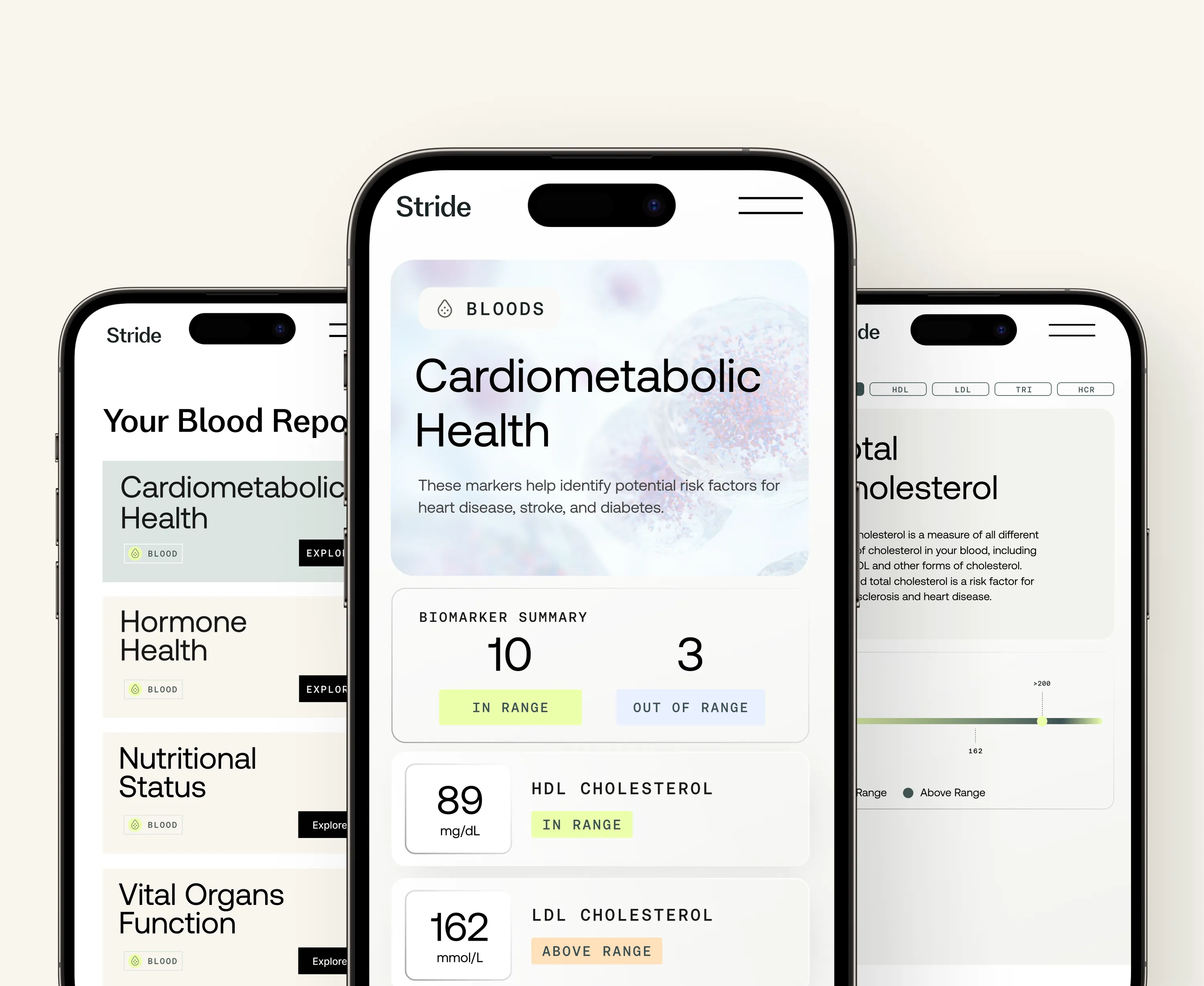
Health Tests
Optimal Bloods
At-home test for more than 70 blood-based biomarkers
From £399 £279.30
Biomarkers
| Biomarker | What it measures | Why it matters | Relevance |
|---|---|---|---|
| TSH Blood Test (Thyroid Stimulating Hormone) | Pituitary signal to thyroid | Suppressed in hyperthyroidism; the primary screening marker | 5 |
| FT4 (Free Thyroxine) Blood Test | Circulating storage form of thyroid hormone | Elevated in overt hyperthyroidism; confirms the TSH signal | 5 |
| FT3 Blood Test (Free Triiodothyronine) | Active form of thyroid hormone | Can be elevated before Free T4 in early Graves'; more closely linked to symptoms | 5 |
| hsCRP Blood Test (High Sensitivity C-Reactive Protein) | Systemic inflammation | Elevated in thyroiditis; helps differentiate from other hyperthyroid causes | 3 |
| Vitamin D Blood Test (25-OH) | 25-OH vitamin D status | Bone protection during hyperthyroidism; deficiency common with autoimmune thyroid disease | 3 |
| LDL Cholesterol Blood Test | Low-density lipoprotein | Often low in hyperthyroidism; normalises with successful treatment | 3 |
| Calcium Blood Test | Serum calcium | Elevated thyroid hormones can affect calcium metabolism and bone turnover | 2 |
| Ferritin Blood Test | Iron storage | Anaemia can co-exist or develop during treatment; important baseline | 2 |
FAQs
What are the most common symptoms of an overactive thyroid in women?
The most common symptoms of an overactive thyroid in women include unexplained weight loss despite a normal or increased appetite, a noticeably fast or irregular heartbeat (palpitations), feeling warm or hot when others are comfortable (heat intolerance), excessive sweating, anxiety and irritability that feels disproportionate, tremor in the hands, disrupted sleep, changes to periods (lighter or less frequent), and diarrhoea or more frequent bowel movements. Not everyone experiences the full constellation — symptoms typically develop gradually over weeks to months. Women aged 20-50 with Graves' disease may also develop changes to the eyes, including a staring appearance or discomfort. Because anxiety, palpitations, and sleep disruption also accompany many other conditions, a thyroid function test — covering TSH, Free T4, and Free T3 — is the quickest way to determine whether the thyroid is involved.
What does a low TSH result mean in a blood test?
TSH (thyroid stimulating hormone) is produced by the pituitary gland to tell the thyroid how much hormone to make. When thyroid hormone levels in the blood are high, the pituitary reduces its TSH output — a feedback loop designed to keep production in balance. A low TSH therefore signals that the pituitary has detected elevated thyroid hormones and has reduced its signalling accordingly. A suppressed TSH is the primary indicator of hyperthyroidism, though it can also occur in subclinical hyperthyroidism (where T4 and T3 are still within normal limits), in people taking too much thyroxine medication, or occasionally as a transient result of illness or another hormonal change. A low TSH always warrants follow-up testing with Free T4 and Free T3 to establish what is driving the suppression.
Is Graves' disease the same as an overactive thyroid?
Graves' disease is the most common cause of an overactive thyroid, accounting for roughly three-quarters of cases, but the two terms are not interchangeable. An overactive thyroid (hyperthyroidism) is the functional outcome — too much thyroid hormone in circulation — while Graves' disease is one specific autoimmune mechanism that produces it. Other causes include toxic thyroid nodules, thyroiditis, and excess iodine intake. The distinction matters because treatment options differ: antithyroid medications may produce remission in Graves' disease if TRAb antibodies become negative, whereas nodular disease typically requires radioactive iodine or surgery. Confirming whether Graves' disease is the cause requires TRAb antibody testing in addition to standard thyroid function tests.
Can an overactive thyroid cause weight loss even if I am eating normally?
Yes. One of the most characteristic features of hyperthyroidism is unexplained weight loss despite a normal or increased appetite. Elevated thyroid hormones significantly increase the body's basal metabolic rate — the amount of energy burned at rest — meaning the body is consuming more calories than usual to maintain normal function. This can produce weight loss of several kilograms over weeks to months, alongside an increased appetite. The weight typically returns as thyroid function normalises with treatment. It is worth noting that weight loss in hyperthyroidism is not selective: muscle mass is also lost alongside fat tissue, which is part of why fatigue and weakness are common even in people who have not significantly changed their activity levels.
Can stress or anxiety be caused by an overactive thyroid?
Yes. Excess thyroid hormone has a direct stimulatory effect on the central nervous system: it increases neurotransmitter sensitivity, elevates heart rate, and activates the sympathetic nervous system — producing symptoms that are almost identical to an anxiety disorder. These include a sense of restlessness or agitation, difficulty concentrating, sleep disruption, and a fast or pounding heartbeat. In some people, the thyroid presentation is the primary one, and anxiety resolves almost completely once thyroid function returns to normal. This is one reason why a thyroid function test — checking TSH at minimum, and ideally Free T3 and Free T4 — is worth including in any investigation of new or worsening anxiety, particularly when accompanied by weight change, heat sensitivity, or irregular heart rhythm.
What is the difference between overactive and underactive thyroid?
An overactive thyroid (hyperthyroidism) produces too much thyroid hormone, speeding up the body's metabolic processes. An underactive thyroid (hypothyroidism) produces too little, slowing them down. The symptom profiles reflect these opposing directions: hyperthyroidism typically causes weight loss, heat intolerance, rapid heart rate, anxiety, and sweating, while hypothyroidism typically causes weight gain, cold intolerance, slow heart rate, fatigue, and low mood. Both conditions are diagnosed through thyroid function testing — TSH, Free T4, and Free T3 — though they produce opposite patterns of results. In Graves' disease (overactive), TSH is low and Free T4/T3 are high. In Hashimoto's (underactive), TSH is high and Free T4/T3 are low. Some people experience both conditions over their lifetime, and some thyroid conditions (including certain phases of thyroiditis) can cause temporary hyperthyroidism before transitioning to hypothyroidism.
How long does it take to treat an overactive thyroid?
Treatment duration depends on the underlying cause and the approach chosen. Antithyroid medications (carbimazole) are typically prescribed for 12-18 months in Graves' disease, with the goal of achieving remission when the immune system's TSH-receptor antibodies reduce to undetectable levels. Remission occurs in roughly 40-50% of people following a course of medication. If remission is not achieved, or if the condition recurs, radioactive iodine therapy or surgery provides more definitive treatment. Radioactive iodine typically normalises thyroid function within 2-6 months but often results in hypothyroidism, requiring lifelong thyroxine replacement. Thyroid function tests are repeated at regular intervals throughout treatment — typically every 4-8 weeks initially, then less frequently once stable.
Can hyperthyroidism affect bone density?
Yes. Elevated thyroid hormones increase the rate of bone remodelling, accelerating the cycle of bone breakdown and formation. Over time, particularly with untreated or longstanding hyperthyroidism, this can lead to reduced bone mineral density and an increased risk of osteoporosis. The risk is highest in postmenopausal women, who have already lost the bone-protective effects of oestrogen. Subclinical hyperthyroidism — a suppressed TSH with normal T4 and T3 — also carries a modest but measurable risk of bone density reduction in this group, which is one reason treatment may be recommended even without overt symptoms. Monitoring vitamin D and calcium levels alongside thyroid function supports bone health during and after treatment.
Find out what your body is actually trying to tell you.
Answer 8 quick questions and get a free personalised report - covering which area of your biology is most worth looking at first, what testing in that area reveals, and what actions become available once you have that data.
Where do you feel you're operating below your potential right now?
Methylation & Cellular Health
Your biology is signalling a methylation upgrade - here’s what that means and what to do about it.