
Menu
-
Shop All
Contact
hey@getstride.com
Stride Health Group
Stride Health Group Ltd
Company No 05158025
Lamas Road
Badersfield
Norwich
England
NR10 5FB
UK









News
8 Minutes
Continuous Glucose Monitors for Non-Diabetics: Useful Health Tool or Unnecessary Biohack?
More people without diabetes are wearing glucose monitors to track their blood sugar. This article weighs the real benefits against the cost, the accuracy limits and the risk of food anxiety, and covers which tests tell you more about long-term glucose health.

 12/10/2026
Why CGMs are moving beyond diabetes care
Continuous glucose monitors (CGMs) were built to help people with diabetes manage their blood sugar. Today, a growing number of people without diabetes wear one to see how food, exercise and sleep affect their glucose in real time.
That raises a fair question: is a CGM a genuinely useful health tool for someone without diabetes, or another biohack that adds cost, confusion and anxiety?
This article explains:
How do CGMs work?
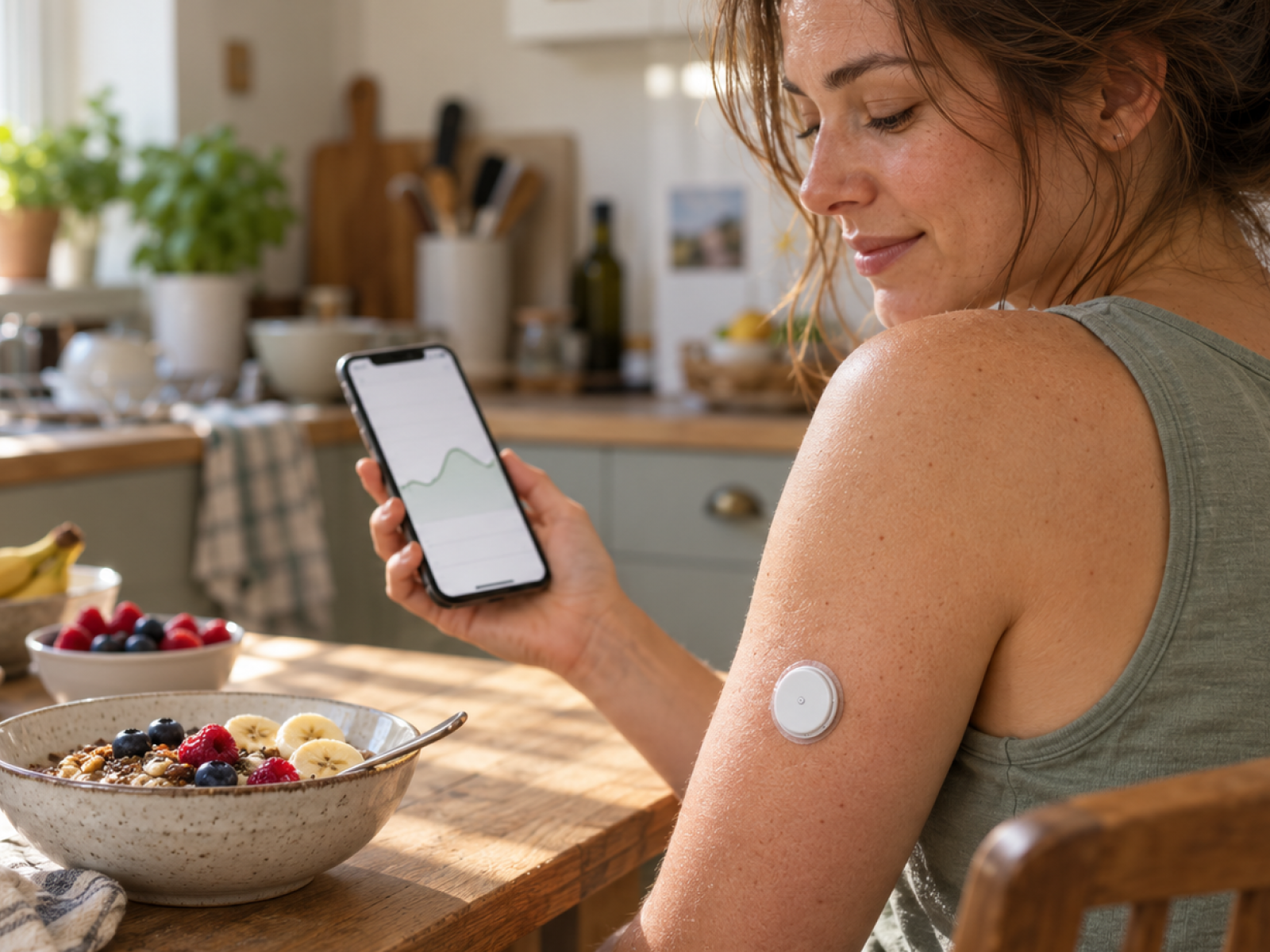
A CGM is a small sensor, usually worn on the back of the upper arm. A thin filament sits just under the skin and measures glucose in the interstitial fluid, the fluid that surrounds your cells. The sensor sends readings to a linked app throughout the day and night, so you never need to prick your finger.
For people with diabetes, particularly those who use insulin, CGMs have transformed day-to-day care. They show how glucose responds to meals, exercise and medication, and they warn of dangerous lows before they happen.
How blood sugar levels affect the body
When you eat carbohydrates, your blood glucose rises. Refined carbohydrates and added sugars, especially when eaten on their own, tend to produce a faster and steeper rise. How far glucose climbs also depends on the individual, the portion size and what else is on the plate.
Your pancreas then releases insulin, a hormone that moves glucose out of the bloodstream and into your cells for energy or storage. Glucose gradually returns towards its baseline. Sometimes a sharp rise is followed by a sharp fall, and some people notice fatigue, hunger or brain fog at that point, even when their glucose stays within the normal range.
Over years, persistently high glucose and impaired glucose regulation are linked to insulin resistance and a greater risk of type 2 diabetes. Poorly managed diabetes can in turn damage the heart, kidneys, eyes and nerves.
A rise in blood glucose after eating is normal and does not, on its own, signal a health problem. No universally agreed definition exists for an unhealthy “spike” in someone without diabetes.
The potential benefits of a CGM
For the right person, used for the right reasons, a CGM can offer some useful insights.
Personal food data
Seeing your own graph rise after a sugary snack can motivate you to swap processed foods for more balanced options.
Self-experimentation
Compare a post-meal walk with sitting down, or test different breakfasts, and learn how insulin and glucagon work behind the scenes.
Support for prediabetes
For people in the “grey zone”, a CGM can reinforce habits such as adding fibre and protein and moving more.
Clarity on energy dips
A CGM can show whether that mid-afternoon slump is really a glucose drop or something else entirely.
Understanding food responses in context
A noticeable glucose rise does not make a food unhealthy. Oats, fruit and other whole-food carbohydrates still belong in a healthy diet. The value lies in understanding how different foods and combinations affect you, not in avoiding every rise. Bear in mind that your response to the same meal can also vary from day to day.
Prediabetes and the “low blood sugar” feeling
A prediabetes diagnosis is the ideal moment to change diet and lifestyle, and a CGM can serve as an educational aid. Even so, CGMs are not routinely needed for prediabetes, and current evidence shows limited long-term benefit beyond established dietary and lifestyle changes.
Many people who skip meals report feeling tired, shaky or irritable in the afternoon and assume their blood sugar has crashed. Hunger, dehydration and stress cause similar symptoms. A CGM can settle the question, although regular, balanced meals usually fix the problem without one.
“Will this information genuinely help me make healthier choices, or will it simply give me another thing to worry about?”
The drawbacks of using a CGM
Cost
Most sensors need replacing every 10 to 15 days, and people without diabetes pay the full price themselves. Over months, that adds up. Whether the spend is worthwhile depends on your goals and whether the data will change what you do.
Food fear and tracking fatigue
Watching glucose rise after a banana, oats or potatoes can lead people to label these foods as unhealthy. The goal quietly shifts from eating well to keeping the graph flat. For anyone prone to food anxiety or restrictive eating, this can feed orthorexic tendencies.
A CGM also adds one more number to a list that may already include steps, sleep, heart rate and calories. Research has already established the fundamentals: pairing carbohydrates with protein, fibre and healthy fats slows glucose absorption, and regular activity and good sleep support metabolic health. You can apply these principles without continuous monitoring.
Glucose is only one part of health
A meal high in saturated fat or salt may barely move your glucose, yet regular excess can raise LDL cholesterol and blood pressure. Fruit, legumes and whole grains may raise glucose while delivering fibre and essential nutrients. Choosing food on glucose response alone produces a lopsided diet.
Accuracy limits
Because CGMs read interstitial fluid rather than blood, they lag slightly behind real blood glucose. Readings are less reliable during rapid changes, at low levels, or when you lie on the sensor. A healthy person may see a false low overnight. Stress, exercise, illness, sleep and hormones also shift glucose, so readings without context can easily cause unnecessary worry.
Better ways to check long-term glucose health
If your main concern is prediabetes or how well your body regulates glucose over time, standard blood tests remain the better starting point. In the UK, an HbA1c of 42–47 mmol/mol or a fasting glucose of 5.5–6.9 mmol/L is generally used to identify a higher risk of type 2 diabetes.
| Test | What it shows | Best suited to |
|---|---|---|
| HbA1c | Average glucose over 2–3 months | Screening for prediabetes |
| Fasting glucose | Glucose after an overnight fast | Baseline regulation |
| Oral glucose tolerance test | Response to a set glucose drink | Specific clinical cases |
| CGM | Minute-by-minute changes | Short-term curiosity |
How often you retest depends on your risk factors and previous results. A blood test that includes HbA1c gives you a reliable picture of glucose control without daily tracking.
Should you try a CGM?
If you are curious about how your body handles different foods and activities, a two-week trial can be an interesting, educational experiment. Treat it as exactly that, rather than a foundation for your entire health routine.
FAQs
Is it worth using a CGM if I don't have diabetes?
A CGM can be an interesting short-term learning tool, but strong evidence that people without diabetes benefit from long-term use is lacking. For most people, balanced meals, regular activity and good sleep matter far more than continuous data.
Are glucose spikes bad for people without diabetes?
A rise in glucose after eating is a normal response. Concern centres on consistently high glucose and impaired regulation over time, which standard blood tests such as HbA1c measure more reliably than individual CGM readings.
How accurate are CGMs?
CGMs are generally reliable, but they measure interstitial fluid, so they lag slightly behind blood glucose. Accuracy drops during rapid changes, at low levels and when pressure is applied to the sensor, for example while sleeping on it.
What is the best test for prediabetes?
HbA1c, which reflects average glucose over two to three months, is the most common screening test in the UK. Fasting glucose is also used, and an oral glucose tolerance test may be recommended in certain situations.
The bottom line
For people without diabetes, a CGM is an interesting experiment rather than an essential health tool, and occasional glucose rises are nothing to fear.
If you want to understand your long-term glucose health, an HbA1c blood test and consistent everyday habits will tell you far more than another stream of data.
Find out what your body is actually trying to tell you.
Answer 8 quick questions and get a free personalised report - covering which area of your biology is most worth looking at first, what testing in that area reveals, and what actions become available once you have that data.
Where do you feel you're operating below your potential right now?
Methylation & Cellular Health
Your biology is signalling a methylation upgrade - here’s what that means and what to do about it.