
Menu
-
Shop All
Contact
hey@getstride.com
Stride Health Group
Stride Health Group Ltd
Company No 05158025
Lamas Road
Badersfield
Norwich
England
NR10 5FB
UK








News
8 Minutes
The Folate Cycle Explained: From Folate to DNA and Methylation
How the folate cycle turns folate into 5-MTHF, builds DNA and feeds methylation, plus the folate trap, the genes involved and which blood tests help.

 20/09/2025
What the folate cycle is
The folate cycle is the set of reactions that turns folate from food, or folic acid from supplements, into active forms your cells can use. Those forms carry single carbon atoms to where they're needed: into the building blocks of new DNA, and into the methionine cycle as 5-MTHF (5-methyltetrahydrofolate), which keeps methylation going.
Scientists often call it folate-mediated one-carbon metabolism. It's a cycle because the folate molecule is reused: it picks up a carbon unit, hands it on, and returns to its starting form, tetrahydrofolate (THF), ready to collect another.
Folate is vitamin B9. Your body can't make it, so everything this cycle runs on has to come from your diet or a supplement.
This article explains:
How folate becomes active, step by step
Folate gets into the cycle in two ways. Folic acid, the synthetic form used in supplements and fortified foods, has to be activated first. Most natural folate from food reaches your blood already as 5-MTHF and joins at the last step.
| Step | What happens | Enzyme (gene) | What it needs |
|---|---|---|---|
| 1. Activate folic acid | Folic acid is reduced to dihydrofolate (DHF), then to THF | Dihydrofolate reductase (DHFR) | NADPH, made using niacin (B3) |
| 2. Load a carbon | THF picks up a one-carbon unit from the amino acid serine, becoming 5,10-methylene-THF | Serine hydroxymethyltransferase (SHMT) | Vitamin B6 |
| 3. Make 5-MTHF | 5,10-methylene-THF is converted to 5-MTHF, the main form of folate in your blood | MTHFR | Riboflavin (B2) |
| 4. Pass on the methyl group | 5-MTHF gives its methyl group to homocysteine, making methionine and returning to THF | Methionine synthase (MTR) | Vitamin B12 |
Step 3 is effectively one-way. Once folate has become 5-MTHF, the only route back to THF is step 4, and step 4 needs vitamin B12. Keep that in mind, because it explains the folate trap further down.
Step 4 is also where the two cycles meet. The methionine made there goes on to form SAMe, the body's main methyl donor, and when SAMe is plentiful it slows MTHFR down. In effect, the methionine cycle tells the folate cycle how much 5-MTHF it needs.
How the folate cycle helps build DNA
Not all of the 5,10-methylene-THF made at step 2 becomes 5-MTHF. Some is diverted into making DNA, and because folate is needed for three of the four DNA bases, every dividing cell depends on it.
Thymidine (T)
Thymidylate synthase uses 5,10-methylene-THF to turn a uracil building block into thymidine. The folate comes out as DHF, and DHFR recycles it back to THF.
Purines (A and G)
MTHFD1 converts one-carbon units into 10-formyl-THF, which supplies two of the carbon atoms in adenine and guanine.
Methyl groups
The share that MTHFR turns into 5-MTHF goes to the methionine cycle, where it ends up in SAMe, the donor for most methylation reactions.
Amino acids
The cycle converts serine into glycine and helps break down histidine. Folate contributes to normal amino acid synthesis.
When folate runs short, cells can't make enough thymidine and start putting uracil into DNA by mistake. Repairing those errors causes breaks in the DNA strands. Fast-dividing cells feel it first. In the bone marrow, that means fewer, larger red blood cells, a condition called megaloblastic anaemia. The lining of the mouth and gut is affected too, and so is a baby developing in early pregnancy.
That's the reason the NHS advises taking 400 µg of folic acid a day while trying to conceive and until 12 weeks of pregnancy, to lower the risk of neural tube defects such as spina bifida. Some women are advised to take a higher dose on prescription. If you'd prefer methylfolate, talk it through with your GP or midwife first.
The folate trap: why B12 matters
The folate trap happens when vitamin B12 is low. Methionine synthase can't work without B12, so folate that has already become 5-MTHF has nowhere to go. It piles up in that form while the cell runs short of THF for making DNA, even if your diet contains plenty of folate.
This has two practical consequences. A blood test can show normal or even high folate in someone whose cells are short of it. And B12 deficiency produces the same kind of anaemia as folate deficiency, because both end in the same shortage of DNA building blocks.
For the same reason, doctors check B12 before treating low folate. Folic acid can enter the cycle through DHFR and sidestep the trap, which may correct the anaemia while an untreated B12 deficiency carries on damaging the nerves. Correcting the B12 releases the trapped folate.
Symptoms to take seriously
The folate trap isn't a diagnosis in itself. Its symptoms are those of B12 or folate deficiency, and they need a blood test rather than guesswork. See your GP if you have:
B12 deficiency can cause lasting nerve damage if it's left untreated, so don't wait to see whether symptoms settle.
Folate, folic acid and methylfolate
The three names get used interchangeably, but they aren't the same thing.
| Form | What it is | Where you'll find it | Good to know |
|---|---|---|---|
| Folate | The natural forms in food | Leafy greens, pulses, asparagus, oranges | Lost in cooking water and with long heating; absorbed less well than folic acid |
| Folic acid | A synthetic, very stable form | Supplements, fortified cereals and, from December 2026, non-wholemeal wheat flour in England | Needs DHFR to activate it; the form used in NHS pregnancy advice |
| Methylfolate (5-MTHF) | The active form your blood carries | Supplements, sometimes labelled L-methylfolate or Metafolin | Skips DHFR and MTHFR; still needs B12 to enter the cycle |
Human DHFR works slowly, and its activity varies a lot between people, so at higher intakes some folic acid reaches the blood unchanged. Researchers are still working out what, if anything, that means for health. It isn't a reason to avoid folic acid, and the NHS pregnancy advice applies whatever your genes.
The appeal of methylfolate is that it's already in the form the cycle uses, which may suit people whose MTHFR variants slow step 3. Our MTHFR guide covers those variants in more detail.
The genes Stride reports for this cycle
The DNA & Methylation Test reports four results for the folate cycle, across three genes:
DHFR activates folic acid and recycles the DHF left over from making thymidine. It also rescues BH4, the helper molecule behind dopamine and serotonin production, after it has been oxidised, which is one of the links to the BH4 cycle. Variants may affect how readily you process folic acid.
MTHFD1 is a three-in-one enzyme that loads carbon units onto THF and moves them between forms, which influences how much goes to building DNA and how much to methylation.
MTHFR C677T is the best-studied folate variant. It lowers MTHFR activity, most of all if you carry two copies, and homocysteine tends to rise mainly when folate and riboflavin intake is low.
MTHFR A1298C has a milder effect on its own and matters more alongside C677T. Stride also includes it in the BH4 cycle.
Across more than 10,000 Stride methylation results, about 40% showed an impaired folate cycle. Only about 2% had fully normal function in both the folate and BH4 cycles.
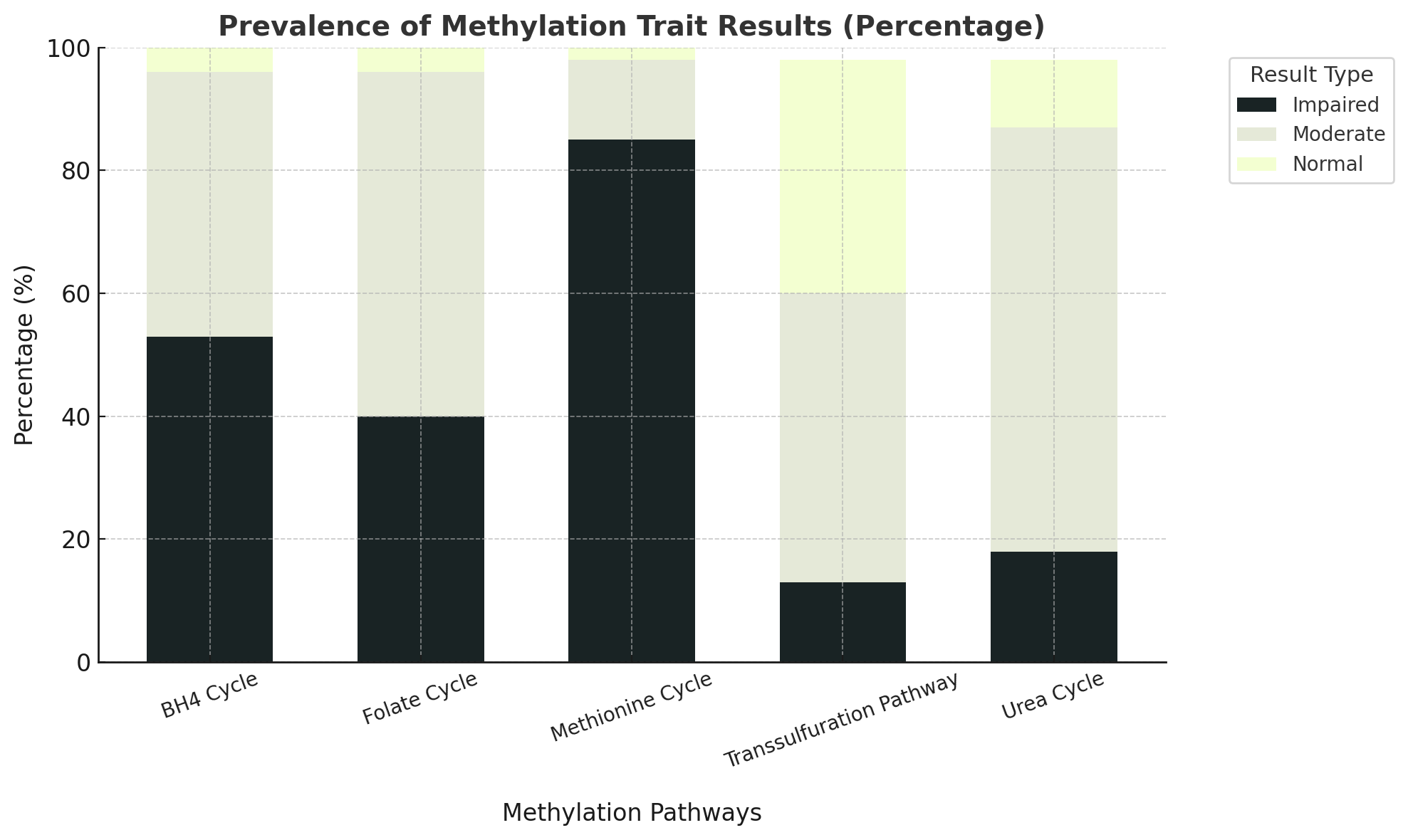
Like any genetic result, this tells you about tendency, not current status. Someone with an impaired folate cycle who eats plenty of greens and pulses may have excellent blood folate, while someone with a normal result who drinks heavily may not.
Supporting your folate cycle
Food comes first. Good sources include spinach, kale, broccoli, Brussels sprouts, asparagus, chickpeas, lentils, black-eyed beans, edamame and oranges. Folate dissolves in water and breaks down with heat, so steaming, microwaving or eating some greens raw keeps more of it.
Partner nutrients matter as much as folate itself. B12 releases folate from 5-MTHF, riboflavin keeps MTHFR working and B6 loads the carbon at step 2. Dairy, eggs, fish and meat supply all three; if you're vegan, you'll need fortified foods or a B12 supplement.
A few things work against it. Alcohol reduces folate absorption and increases how much you lose in urine. Some medicines, including methotrexate and certain anti-epileptic drugs, interfere with folate on purpose or as a side effect. Keep taking them as prescribed and ask your GP whether you need monitoring.
If you'd like a supplement, MS-01 Methylation Support provides 400 µg of folate as methylfolate, with methylcobalamin and vitamin B6 as P5P. Folate contributes to normal homocysteine metabolism and to the reduction of tiredness and fatigue. There's more on food and habits in how to support methylation naturally.
Testing your folate status
Your genes tell you how your folate cycle is built. Blood tests tell you how it's doing now. Ideally, look at these together:
Folate. Serum folate reflects recent intake, while red blood cell folate gives a longer-term picture of the past few months.
Active B12. Worth testing alongside folate, because low B12 traps folate and can make a folate result look better than it is.
Homocysteine. A functional marker that rises when folate, B12, B6 or riboflavin is short. It isn't part of Stride's blood test, so ask your GP.
Optimal Bloods (UK only) includes folate and active B12 among more than 70 biomarkers, with the sample taken at home by a professional. It's also part of the StrideOne membership, which retests bloods every six months.
FAQs
What does the folate cycle do?
It turns folate into active forms that carry single carbon units. These are used to make thymidine and purines for DNA, to convert amino acids such as serine and glycine, and to produce 5-MTHF, which the methionine cycle needs to recycle homocysteine and make SAMe.
What is the folate trap?
It's what happens when vitamin B12 is low. Folate gets stuck as 5-MTHF because methionine synthase needs B12 to release it, so cells run short of usable folate even when blood folate looks normal or high. Correcting the B12 releases it.
Should I avoid folic acid if I have an MTHFR variant?
No. Folic acid still works, and the NHS advice to take 400 micrograms a day while trying to conceive and until 12 weeks of pregnancy applies whatever your MTHFR result. Methylfolate is an alternative you can discuss with your GP or midwife.
What are the symptoms of low folate?
Tiredness, low energy, breathlessness, a sore red tongue, mouth ulcers and pins and needles are common. They overlap with B12 deficiency and many other conditions, so see your GP for a blood test rather than guessing.
The bottom line
The folate cycle activates folate, uses it to build DNA, and hands 5-MTHF to the methionine cycle to keep methylation running. MTHFR, DHFR and MTHFD1 shape how efficiently it works, and vitamin B12 decides whether folate can move through it at all.
Eat plenty of folate-rich plants, cover B12, B6 and riboflavin, and check folate and active B12 in your blood before deciding whether you need more than food can give.
Find out what your body is actually trying to tell you.
Answer 8 quick questions and get a free personalised report - covering which area of your biology is most worth looking at first, what testing in that area reveals, and what actions become available once you have that data.
Where do you feel you're operating below your potential right now?
Methylation & Cellular Health
Your biology is signalling a methylation upgrade - here’s what that means and what to do about it.