
Menu
-
Shop All
Contact
hey@getstride.com
Stride Health Group
Stride Health Group Ltd
Company No 05158025
Lamas Road
Badersfield
Norwich
England
NR10 5FB
UK





News
8 Minutes
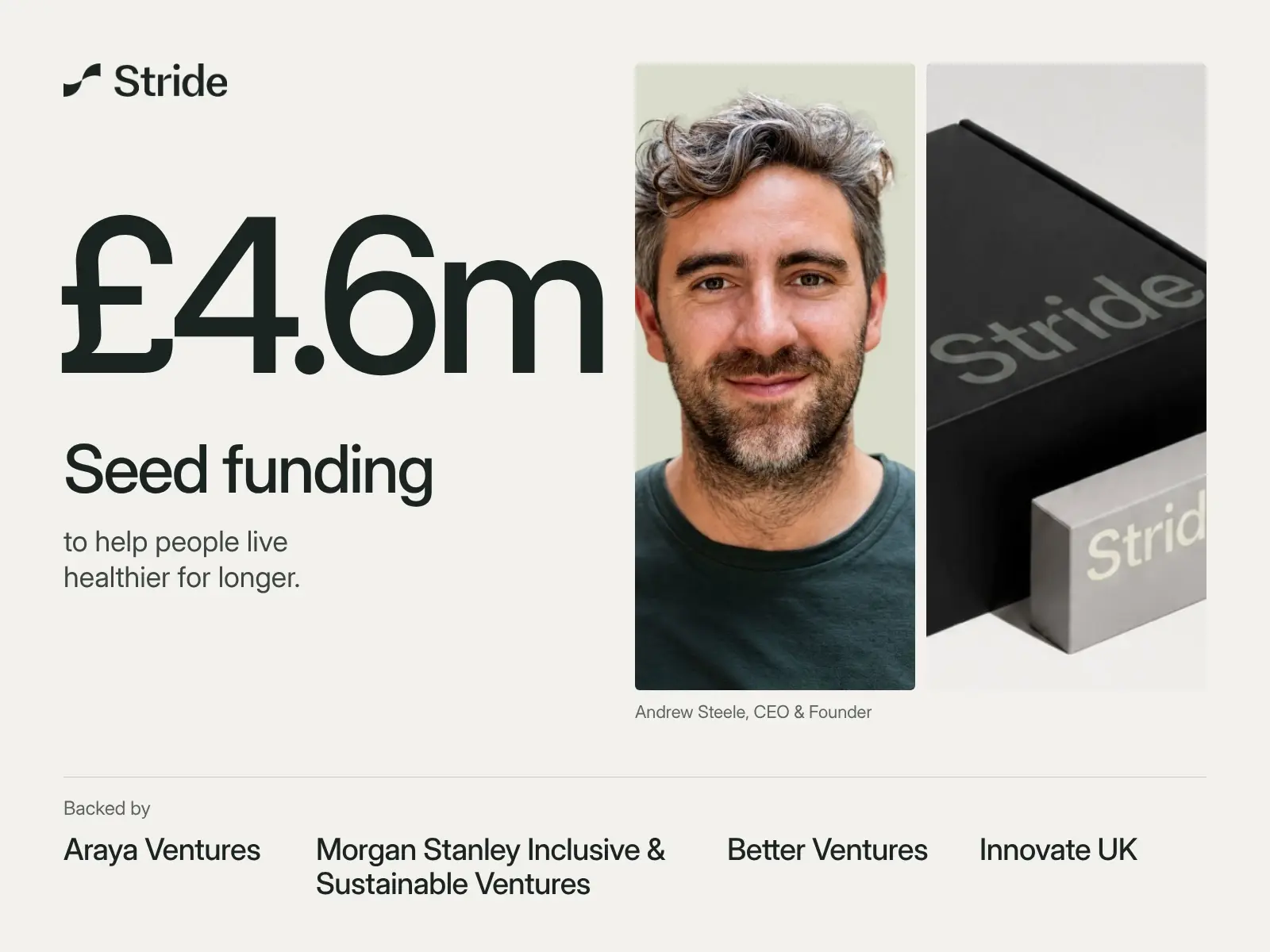
Why I raised £4.6m to make preventative health as common as the iPhone
Olympian and Stride founder Andrew Steele on our £4.6m raise, the US launch of Stride One, and why an elite athlete’s support team should be available to everyone.
 14/10/2026
A new chapter for Stride
Stride has closed its first external funding round: a £4.6m seed from Arāya Ventures, Better Ventures, Morgan Stanley Inclusive & Sustainable Ventures and Innovate UK, alongside some incredible angel investors. I spoke to City AM this week about where the money is going, and I want to share the fuller story here.
My ambition is to give everyone the joined-up health support I had as an athlete, at a price that feels as normal as a phone contract.
This article explains:
From the 400m track to health tech
I won the British 400m title in 2007 and ran in Team GB’s 4 x 400m relay squad at the Beijing 2008 Olympics. We finished just off the podium. Nine years later, after the Russian team was disqualified for doping, our squad was upgraded to bronze.
Missing that medal, then missing selection for London 2012, forced me to plan life after athletics years sooner than I expected. I had no degree, no work experience and no money, so I said yes to every opportunity that came my way.
One of those opportunities became DNAfit, a genetic testing company I co-founded and sold to global health group Prenetics in 2018. Stride is my next chapter, and it brings together everything I learned on both sides of the testing table.
There is an irony here. Weak drug testing cost me a medal on the night, and better testing handed it back years later. Now my working life centres on biological measurement.
An Olympic support team, for everyone
As an athlete, I had a team of specialists around me. Each one produced data, but that data only became useful because my coach filtered it and turned it into clear decisions about what would make me run faster.
Nutritionist
Matched my food and fuelling to training load and recovery.
Strength and conditioning
Built the physical base that speed and resilience depend on.
Psychologist and physio
Looked after my mind and my body’s wear and tear.
The coach
Triaged every input and decided what actually mattered.
The training was never easy, but with that support, being healthy was. When I retired, the system vanished overnight. No data, no coach, no guidance, and my health went backwards.
I built Stride to give everyone that level of care. Most people now have plenty of health data from a watch, a ring or a one-off blood test. Few have anyone to connect it, prioritise it and turn it into a plan they can follow.
Most companies in this space put your results on a dashboard, leave you to it and call that empowerment. We analyse a lot of data too, but we focus on the outcome: a short, actionable plan, with a practitioner always in the loop.
“Health shouldn’t be harder than an Olympic training block.”
Why one test is never the full picture
Most of the conditions that affect us in later life, from heart disease to type 2 diabetes, develop quietly over many years. By the time symptoms appear, the underlying changes have often been building for a decade or more. Research suggests that everyday factors such as diet, movement, sleep and stress play a major part in that process, which means there is a long window in which small changes can make a real difference.
The problem is visibility. Without measurement, you can’t see what is shifting inside your body, so you can’t tell whether your efforts are working.
Each type of test answers a different question, and each changes on a different timescale. Your genes stay fixed for life. Your blood markers and gut bacteria shift with diet, sleep, stress and exercise. Reading them together gives a far clearer picture than any one result on its own.
| Test type | What it shows | How often it changes |
|---|---|---|
| DNA | Inherited tendencies and predispositions | Fixed for life |
| Blood biomarkers | Current internal health markers | Weeks to months |
| Gut microbiome | Balance of gut bacteria | Responds to diet |
| Combined view | How your habits interact with your biology | Tracks progress over time |
Combining these layers with expert consultation and targeted supplements is the core of what we offer at Stride. In practice, it works as a cycle rather than a one-off event.
Test
We start with a baseline: your genetic tendencies, your current blood markers and the state of your gut. That baseline shows where you are strong and where you have room to improve. If you’re not sure where to begin, our free health assessment points you to the area most worth testing first.
Interpret
Raw results are just numbers. Our qualified dietitians and nutrition experts translate them into a short list of priorities, the same way my coach filtered what my support team told him.
Act
You make a few targeted changes to food, training, sleep or supplements. Small, specific actions are easier to keep up than a complete overhaul. We make our own high-absorption liposomal supplements, so your protocol is built around your results.
Retest
Retesting matters as much as the first test, because it shows whether a change in routine has actually moved the markers you care about. Then the cycle begins again.
Testing supports better decisions about lifestyle, but it does not replace your GP. Always speak to a doctor about symptoms or before changing any treatment.
What the new funding pays for
We will put the seed round into three main areas of growth.
A wider product range
More ways to measure and track the factors that shape long-term health.
A biological age test
A multi-source test, now in development, that draws on several data types at once.
StrideOne in the US
Our membership programme launches for American customers.
StrideOne rests on a simple bet: the more valuable each insight is, and the more it helps someone improve day to day, the longer they stay with us. The early results back it up.
Thank you to our members and customers
First, thank you. Every one of our more than 16,000 customers who has sent off a sample, read their results and made a change has helped build Stride. You trusted us with something as personal as your health, and we never take that lightly.
That 85% figure belongs to our members. It reflects people who did their first test, made a change and came back to see whether it worked. Building a habit around your health takes patience, and you have shown it.
Your questions and feedback shape what we build next, and your commitment is a big reason investors backed us.
So, from me and the whole Stride team: thank you. Whether you joined in our first month or last week, you are the reason this next chapter is happening. My thanks too to our investors for backing the vision, and to the team who got us here.
Making preventative health as common as the iPhone
The comparison is deliberate. Millions of people own a phone costing around £1,000. It isn’t cheap, but it is widely affordable, and few would now call it a luxury. I believe that within five to ten years, managing your own preventative health can reach the same point as costs fall and scale grows.
Wearables made the same journey. Tracking sleep and heart rate variability was once niche, elite-sport stuff, and now millions do it without thinking. Regular testing and expert interpretation can become just as routine.
I left athletics wanting to give everyone the kind of support that made me a better athlete. That is still the whole point of Stride: more healthy years, for more people.
Everything until now was the warm-up. Join us on our mission to help millions of people go from normal to optimal.
I talked through the funding, my Olympic story and the iPhone comparison with City AM. Read the full interview on City AM.
FAQs
Who founded Stride?
Stride was founded by Andrew Steele, a former British 400m champion and Olympic bronze medallist in the 4 x 400m relay at Beijing 2008. He previously co-founded the genetic testing company DNAfit, which was acquired by Prenetics in 2018.
How much has Stride raised?
Stride raised £4.6m in its seed round, its first external funding. Investors include Arāya Ventures, Better Ventures, Morgan Stanley Inclusive & Sustainable Ventures and Innovate UK, alongside angel investors.
What is StrideOne?
StrideOne is Stride’s membership programme. It combines DNA, blood and gut testing with one-to-one support from qualified dietitians and supplements, so members can track their health and improve it over time rather than relying on a single snapshot.
Is Stride available in the US?
Part of the new funding will pay for the launch of StrideOne in the US. Some tests, including the Stride blood test, are currently available in the UK only.
What is a biological age test?
A biological age test estimates how old your body appears at a biological level, which can differ from your age in years. StrideOne already includes a biological age estimate based on nine blood biomarkers, and Stride is developing a multi-source test that draws on several types of health data at once.
The bottom line
Our £4.6m funding round will widen our testing range, develop a multi-source biological age test and take StrideOne to the US.
The aim stays the same: give everyone the joined-up, coached approach to health that I relied on as an athlete, at a price that feels normal.
To every Stride member and customer, thank you for getting us here.
Find out what your body is actually trying to tell you.
Answer 8 quick questions and get a free personalised report - covering which area of your biology is most worth looking at first, what testing in that area reveals, and what actions become available once you have that data.
Where do you feel you're operating below your potential right now?
Methylation & Cellular Health
Your biology is signalling a methylation upgrade - here’s what that means and what to do about it.