
Menu
-
Shop All
Contact
hey@getstride.com
Stride Health Group
Stride Health Group Ltd
Company No 05158025
Lamas Road
Badersfield
Norwich
England
NR10 5FB
UK








News
8 Minutes

Eating for a calmer, sharper mind
Your mood, focus, motivation, and sleep are more than just psychological experiences, they are chemical events. Every time you feel a rush of motivation, drift into calm, or struggle to concentrate, a small cast of brain chemicals called neurotransmitters is behind it. And every one of those chemicals is built from raw materials you get through food.

 03/09/2026
Eating for a calmer, sharper mind
Your mood, focus, motivation and sleep aren’t only psychological experiences — they’re chemical events. Behind every wave of motivation, every settling into calm and every lapse in concentration sits a small cast of brain chemicals called neurotransmitters. And each of those chemicals is built from raw materials you supply through food.
No single “brain food” fixes your mood. But neurotransmitters are manufactured moment to moment from amino acids, vitamins and minerals, and consistently under-supplying those building blocks makes it harder for your brain to keep production up. Here’s a food-first guide to the messengers linked to mood and cognition — and what to eat to support them.
This article explains:
What your neurotransmitters actually are
Think of neurotransmitters as messengers that carry signals between brain cells. Each has a slightly different job, and each is built from a precursor nutrient — usually a specific amino acid — with vitamins and minerals acting as the tools, or cofactors, that finish the job. When the raw materials or the tools run short, production can lag.
| Messenger | What it’s linked to | Main building block |
|---|---|---|
| Serotonin | Calm, contentment, emotional stability | Tryptophan |
| Dopamine | Motivation, reward, focus | Tyrosine |
| Norepinephrine | Alertness, stress response | Tyrosine |
| GABA | Calm, easing anxiety | Glutamate (magnesium cofactor) |
| Acetylcholine | Memory, learning, clarity | Choline |
The building blocks: eating for each messenger
Serotonin: the calm-and-content messenger
Serotonin is made from tryptophan, an essential amino acid your body can’t produce itself, so it depends entirely on your diet. Reviews of controlled trials in healthy adults suggest that adequate tryptophan intake is linked to more positive mood and fewer negative feelings, and depletion studies — where tryptophan is deliberately lowered — show mood can dip, particularly in people already prone to low mood.
Food-first sources: turkey, chicken, ham, eggs, oats, cheese, tofu and other soy foods, pumpkin seeds, tuna and salmon.
One useful detail: tryptophan competes with other amino acids to reach the brain, and it crosses more easily alongside carbohydrates — part of why a bowl of porridge with nuts, or a turkey sandwich, can feel quietly settling.
Dopamine and norepinephrine: motivation and alertness
Dopamine and norepinephrine are both built from tyrosine, another amino acid found in protein-rich foods. Human research suggests tyrosine is most useful for protecting cognitive performance — things like working memory and processing speed — under short-term stress or heavy mental demand, rather than as a general mood lift. In other words, it helps you keep your edge when you’re under pressure.
Food-first sources: lean beef and lamb, chicken, turkey, fish, eggs, dairy, almonds, avocados, bananas and pumpkin seeds.
Because tyrosine also relies on iron and B vitamins as cofactors, a diet chronically low in these can blunt dopamine production even when tyrosine intake looks fine on paper.
GABA: the brain’s calming brake
GABA is the brain’s main inhibitory messenger — the brake that lets your nervous system switch off after a stressful moment. Magnesium plays a supporting role, and systematic reviews suggest it may improve measures of anxiety and sleep, with the clearest signal in people already prone to anxiety, though researchers note more high-quality trials are needed.
Food-first sources: leafy greens like spinach and chard, pumpkin seeds, almonds, black beans, cashews and dark chocolate.
Certain gut bacteria — particularly some Lactobacillus species in fermented foods — can also produce GABA directly, one more reason fermented foods keep appearing in brain-health research.
Acetylcholine: memory and mental clarity
Acetylcholine is built directly from choline, one of the more underappreciated nutrients in everyday diets. Long-term cohort studies following adults for years have linked higher dietary choline with better cognitive scores and a slower rate of cognitive decline in both men and women. Since most people don’t reach the recommended intake, it’s a genuinely practical nutrient to pay attention to if memory and clarity matter to you.
Food-first sources: eggs (especially the yolk), liver, salmon, chicken, soybeans, and cruciferous vegetables like broccoli, cauliflower and Brussels sprouts.
“You can’t out-supplement a diet that never delivers the raw materials in the first place.”
The B vitamin trio: B6, folate and B12
Vitamins B6, folate (B9) and B12 rarely get the spotlight, but they’re essential cofactors for building serotonin, dopamine and other neurotransmitters — part of the machinery, not just the raw material. Reviews link low folate and B12 with reduced neurotransmitter production, higher homocysteine (a marker tied to poorer brain health) and a greater risk of low mood and cognitive difficulty.
Vitamin B6
Supports serotonin and dopamine synthesis. Found in poultry, fish, chickpeas, bananas and potatoes.
Folate (B9)
Feeds the pathway your brain uses to make serotonin and dopamine. Found in leafy greens, lentils, beans, asparagus and fortified grains.
Vitamin B12
Needed for healthy neurotransmitter production. Found in meat, fish, eggs and dairy — plant-based eaters may need a fortified source or supplement.
Don’t forget your gut
It’s tempting to picture neurotransmitter production as something that happens only in the brain, but much of your body’s serotonin activity is shaped by your gut microbiome. Reviews of the microbiota-gut-brain axis describe how diets rich in prebiotic fibre and fermented foods support microbial diversity and the production of short-chain fatty acids, which appear to help steady stress responses and emotional regulation.
This doesn’t mean gut bacteria top up your brain’s neurotransmitters directly — most gut-produced neurotransmitters can’t cross into the brain. But the gut talks to the brain through the vagus nerve and the immune system, and a well-fed microbiome seems to support that conversation.
Practical additions: natural yoghurt, kefir, sauerkraut, kimchi, olives and pickles in brine, plus a good variety of fibre from onions, garlic, oats and legumes.
A day that supports your brain
You don’t need to overhaul everything overnight. A single day can naturally support several pathways at once:
Breakfast: scrambled eggs (tryptophan, choline, tyrosine) on wholemeal or sourdough toast (complex carbs to help tryptophan reach the brain), with spinach or tomato (magnesium, folate).
Lunch: grilled chicken or salmon (tyrosine, B6, B12) with a large leafy salad and pumpkin seeds (magnesium).
Snack: natural yoghurt (gut support) with berries and almonds (magnesium, tyrosine).
Dinner: a lentil or chickpea dish (folate, B6) with steamed broccoli (choline) and a square of dark chocolate (magnesium).
Why genetics adds another layer
Everything above applies broadly — but not everyone processes these nutrients the same way. Small, common variations in specific genes can change how efficiently your body builds, breaks down or recycles neurotransmitters, which is part of why two people can eat similarly and feel different effects.
A few examples: the COMT enzyme helps clear dopamine and noradrenaline from the brain, and a well-studied variant changes how quickly that happens. The related MAOA and MAOB enzymes break serotonin and dopamine down once they’ve done their work, and variants here can affect how long those signals linger. The MTHFR gene influences how well you process folate — feeding the pathway your brain uses to make serotonin, dopamine and noradrenaline — so a less efficient variant may benefit from steadier nutritional support. And PEMT, which lets your body make some of its own choline, has a common variant that lowers that internal supply, meaning some people lean far more heavily on dietary choline than others.
These variants aren’t diagnoses, and none of them decides your mood or memory on its own — genetics is one layer among many, alongside sleep, stress, movement and overall diet quality.
What they do explain is variability: why identical eating habits can affect two people differently. A DNA-informed approach, like the Stride DNA test, can show which of these pathways may be worth closer attention, so the food-first strategies above can be tailored more precisely to your own biology.
FAQs
Can food really change my mood?
Not instantly, and not on its own — but consistently supplying the amino acids, vitamins and minerals your brain uses to build neurotransmitters gives it the raw materials to work well. Diet is one meaningful piece of the picture, alongside sleep, stress and movement.
Do I need supplements, or is food enough?
For most people, a varied diet covers these building blocks. Choline and B12 are common shortfalls worth watching, and fully plant-based eaters in particular may need a B12 source. It’s best to speak to a doctor before starting any supplement.
Why do carbohydrates help with tryptophan?
Tryptophan competes with other amino acids to reach the brain, and eating it alongside carbohydrates helps it cross more easily. That’s part of why a meal combining protein and carbs can feel quietly settling.
Does my DNA affect how I respond to these foods?
It can. Common variants in genes like COMT, MTHFR and PEMT change how efficiently you build or recycle neurotransmitters and how much dietary choline you need, which is one reason identical eating habits can affect two people differently.
When should I see a doctor rather than change my diet?
If you’re experiencing persistent low mood, anxiety, or changes in memory or concentration, speak to a doctor. Nutrition supports everyday mental clarity and resilience, but it isn’t a replacement for medical care.
The bottom line
Your brain runs on what you feed it: amino acids for the messengers, vitamins and minerals as the tools, and a well-fed gut to support the whole system.
Build meals around enough protein, plenty of colourful plants and a place for fermented and fibre-rich foods — and if you want to know which pathways deserve closer attention, your genetics can help you personalise the approach.
Find out what your body is actually trying to tell you.
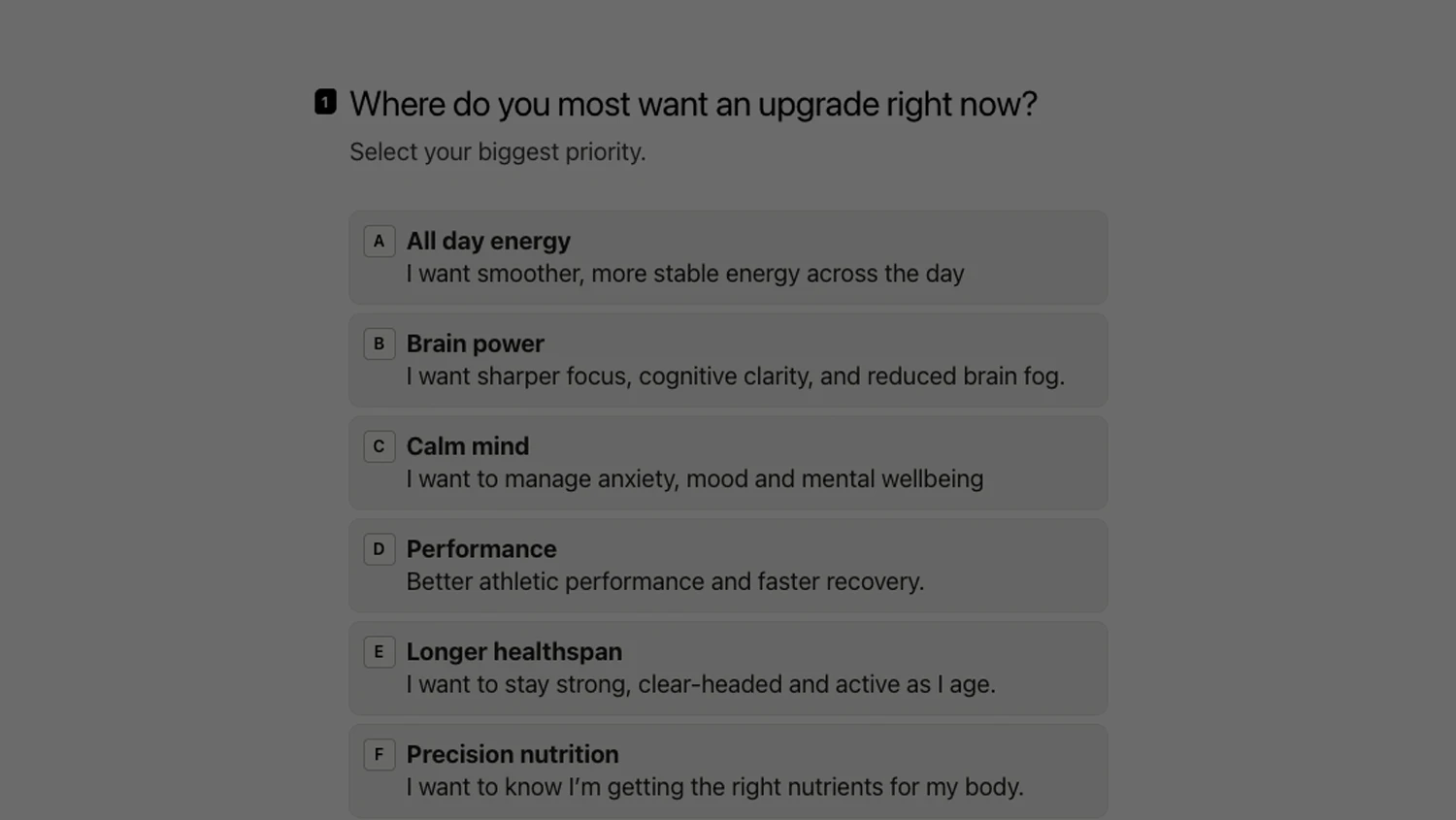
Answer 8 quick questions and get a free personalised report - covering which area of your biology is most worth looking at first, what testing in that area reveals, and what actions become available once you have that data.
Where do you feel you're operating below your potential right now?
Methylation & Cellular Health
Your biology is signalling a methylation upgrade - here’s what that means and what to do about it.