
Menu
-
Shop All
Contact
hey@getstride.com
Stride Health Group
Stride Health Group Ltd
Company No 05158025
Lamas Road
Badersfield
Norwich
England
NR10 5FB
UK









News
8 Minutes
What does liposomal mean, and are liposomal supplements worth it?
Liposomal means a nutrient is wrapped in tiny phospholipid spheres. How liposomes work, what the evidence shows, safety, and how to choose a good one.

 17/06/2025
What liposomal means
Liposomal means the nutrient is wrapped in a liposome: a tiny sphere made of phospholipids, the same type of fat that forms your cell membranes. A liposomal supplement seals a vitamin, mineral or plant compound inside these spheres, usually in a liquid or gel, with the aim of helping more of it survive digestion and reach your bloodstream.
The word comes from two Greek roots: lipos, meaning fat, and soma, meaning body. A liposome is, quite literally, a small fatty body.
Whether the wrapping makes a real difference depends on the nutrient and the product. The best evidence is for vitamin C, where several small trials show higher blood levels than the same dose in standard form. For many other nutrients the research is thin, and quality varies a lot.
This article explains:
How liposomes are made
Each phospholipid molecule has a head that's attracted to water and two tails that avoid it. Put phospholipids in water and they line up tail to tail, forming a double layer that curves round and closes on itself to make a hollow ball. Your cell membranes are built on the same double-layer design.
That structure gives a liposome two places to carry things. Water-soluble nutrients, such as vitamin C and the B vitamins, sit in the watery core. Fat-soluble ones, such as vitamins D and E or curcumin from turmeric, tuck into the fatty layer itself.
To make them, manufacturers mix phospholipids with water and the nutrient, then use mechanical energy (high-pressure homogenisation, ultrasound, or forcing the mixture through very fine filters) to break it into small spheres. The phospholipids usually come from sunflower or soy lecithin, occasionally egg. Finished liposomes range from roughly 20 nanometres to over a micrometre across, far smaller than a red blood cell.
Liposomes weren't invented by the supplement industry. Alec Bangham first described them at the Babraham Institute near Cambridge in the 1960s, and some cancer and antifungal medicines now use them. Those medicines are mostly injected and made to pharmaceutical standards. A swallowed supplement has a harder route to travel.
Why use them in supplements
Manufacturers point to several possible advantages:
Protection
The phospholipid shell is meant to shield its contents from stomach acid and digestive enzymes on the way through.
A different way in
Vitamin C is normally absorbed through transporters that get less efficient as the dose rises. Liposomes may rely on them less.
Gentler on the stomach
Less contact with the gut lining could mean less upset from vitamin C or iron. Plausible, but not well tested.
Easier to mix
Compounds that won't dissolve in water, such as curcumin, can be carried evenly through a liquid.
There's a catch. Your gut is designed to break fat down. Bile salts and fat-digesting enzymes can split liposomes open, and laboratory work on oral drug delivery shows standard liposomes can leak much of their contents in gut-like conditions. How many survive intact in a real person, and how the survivors are absorbed, is still debated. That's one reason results differ so much between products.
Liposomal describes how a nutrient is packaged. Liposomal vitamin C is still vitamin C, and any benefit comes from the vitamin inside.
What the research shows
Most studies of liposomal supplements measure how much of the nutrient shows up in the blood in the hours after a single dose. That's a sensible first question, but higher blood levels don't automatically mean better health, and few studies have looked further.
Vitamin C has the strongest case
Vitamin C has the most human research by some distance. In a 2024 double-blind crossover trial, 27 healthy adults took 500 mg of liposomal vitamin C, 500 mg of standard vitamin C and a placebo on separate days. The liposomal version gave a 27% higher peak in plasma and 21% more vitamin C in the blood across 24 hours, with higher levels inside white blood cells too. The company that sells the liposomal ingredient funded the study.
A 2025 review gathered ten studies comparing liposomal and standard vitamin C. Nine found higher blood levels with the liposomal form. The gap varied enormously, from about 1.2 to more than five times higher at peak, because the products, doses and sampling times were so different, and every study had industry funding or industry-employed authors. A fair reading is that liposomal vitamin C does raise blood levels more than the same dose of ordinary vitamin C, at least in the short term.
Other nutrients are at an earlier stage
Two small trials of liposomal multivitamins, both funded by manufacturers, found differences for some nutrients and not others. In one, with 25 adults, blood iron rose more in the six hours after the liposomal version than after a standard multivitamin. Human studies on vitamin D are few and mixed, and most of the data on liposomal curcumin comes from the lab and animals.
| Nutrient | Human research so far | Evidence |
|---|---|---|
| Vitamin C | Several small crossover trials, most showing higher blood levels | Strongest |
| Glutathione | One small pilot study without a placebo group | Early |
| Multivitamins | Two small trials; higher blood levels for some nutrients, such as iron, but not others | Mixed |
| Vitamin D | A few small studies with mixed results | Mixed |
| Curcumin | Mostly lab and animal studies for liposomal forms | Limited |
Product quality varies
The bigger unknown is what’s actually in the bottle. There’s no agreed standard for what counts as liposomal, and independent testing of products on sale is rare, so two products with the same word on the label can be very different inside.
What is liposomal good for?
Liposomal delivery makes most sense for nutrients that are poorly absorbed, break down easily in the gut, or cause stomach upset in larger amounts. Vitamin C ticks two of those boxes. The share your body absorbs falls as the dose goes up, and big doses can loosen the bowels. It’s also the liposomal supplement you'll see most often.
Because most come as liquids or gels, liposomal products can also suit people who find tablets hard to swallow.
The liposome itself doesn't do anything special for your body. Phospholipids are an ordinary part of food (lecithin is a common ingredient in chocolate and spreads), and your body digests them much as it does other dietary fats. Any benefit comes from the nutrient inside, and only if you needed more of it. If a standard supplement already keeps your levels where they should be, there's little reason to switch.
Are liposomal supplements safe?
For most people, yes. Liposomal supplements are generally well tolerated, and the phospholipids they're made from are normal food ingredients. A few things are still worth checking.
Allergens. Phospholipids are often made from soy, and sometimes egg. Both are among the 14 allergens that must be highlighted on UK food labels. Sunflower lecithin is a common alternative.
- Dose. If a liposomal form gets more of a nutrient into your blood, the label dose matters more, because upper safe levels were set with standard forms in mind. Stick to the recommended amount and don’t double up on products containing the same nutrients, especially vitamins A and D, which build up in the body.
Your circumstances. If you're pregnant, breastfeeding, taking medication or managing a health condition, speak to your GP or pharmacist before starting a new supplement.
The downsides
Even a well-made liposomal supplement comes with trade-offs.
Cost. Making and stabilising liposomes adds expense, so you'll usually pay more per dose.
Taste. Phospholipids can taste fatty or slightly bitter, so most products are flavoured. Some people never quite get used to them.
Shelf life. Liposomes can leak, clump or oxidise over time, especially when warm. Follow the storage instructions; some products need the fridge once opened.
Evidence gaps. Outside vitamin C the research is limited, and there's almost nothing on long-term health outcomes.
Liposomal vs methylated
The two words often share a label, but they describe different things. Liposomal is about delivery: how a nutrient is packaged. Methylated is about the nutrient's chemical form. Methylfolate (5-MTHF) is the active folate your MTHFR enzyme normally makes, and methylcobalamin is one of the two active forms of vitamin B12. Taking them ready-made can be relevant if you carry gene variants, such as in MTHFR, that make those conversions less efficient.
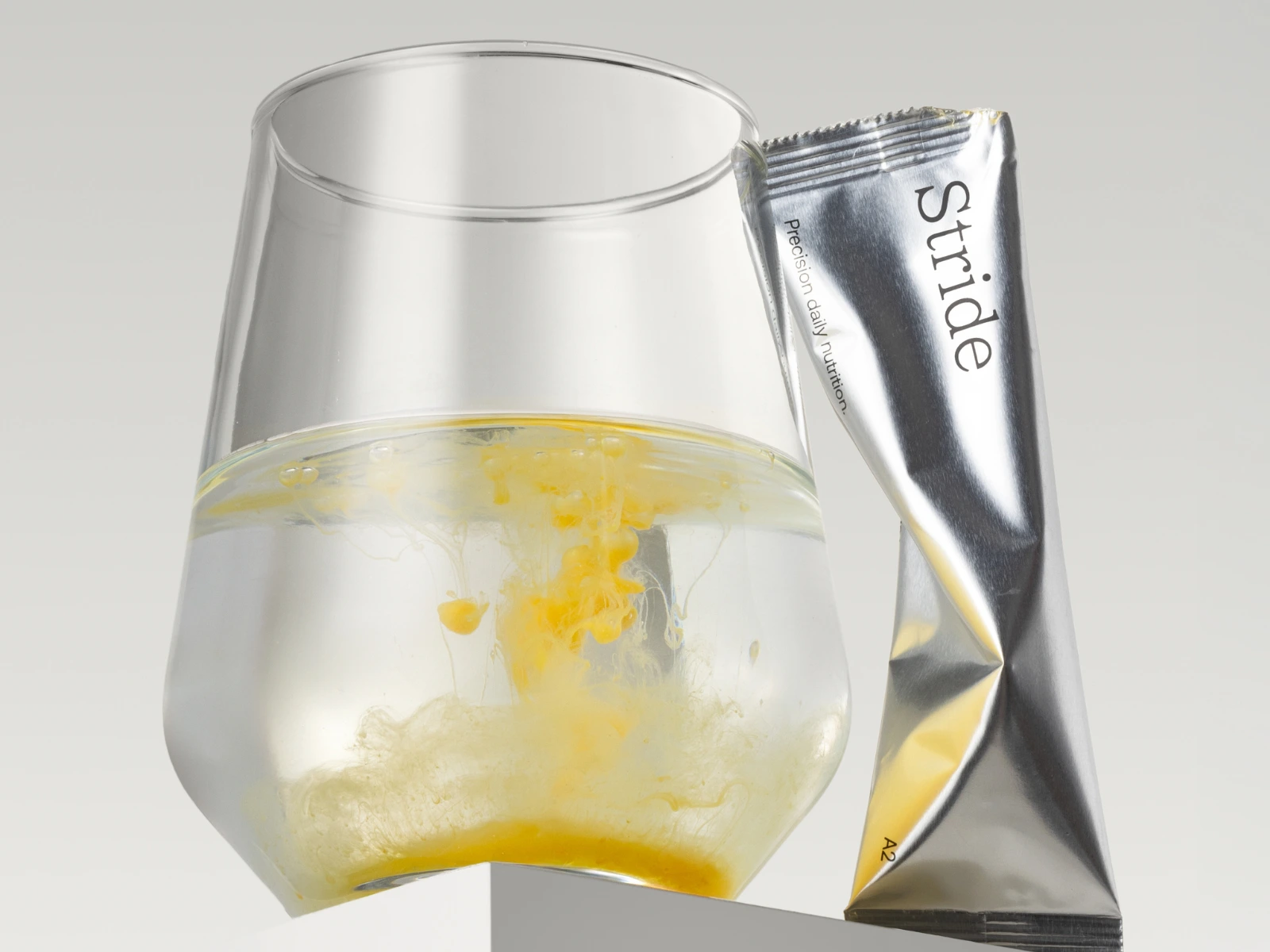
A supplement can be liposomal, methylated, both or neither. Stride's SD-01 StrideDaily is both: a liposomal liquid multivitamin with methylfolate (as Metafolin), methylcobalamin and vitamin B6 as P5P, designed to help protect its nutrients through digestion. We explain the thinking behind it in Liposomal and methylated vitamins: what makes SD-01 different.
How to choose a liposomal supplement
You can't see liposomes on a label, so choosing well means asking the right questions.
Some brands publish test data, such as particle size or encapsulation efficiency: the share of the nutrient that ends up inside the liposomes rather than loose in the liquid. It’s a useful sign that a product has been checked. Marketing language with no numbers behind it tells you very little.
The first check matters most. A blood test can show if you're actually low, and Optimal Bloods (UK only) includes vitamin D, folate, active B12 and ferritin (your iron stores), which covers several of the nutrients people most often supplement.
FAQs
What does liposomal mean in vitamins?
It means the vitamin is enclosed in liposomes, tiny spheres made of phospholipids, to help protect it during digestion and improve absorption. The vitamin itself is the same; only the way it's delivered changes.
Are liposomal vitamins better than normal vitamins?
Sometimes. For vitamin C, several small trials show higher blood levels than the same dose in standard form. For most other nutrients the evidence is limited and product quality varies, so liposomal isn't automatically better.
What is liposomal good for?
Mainly nutrients that are poorly absorbed, break down easily in the gut or upset the stomach in larger doses. Vitamin C is the best-studied example. Liquid liposomal products can also suit people who struggle to swallow tablets.
Are liposomal supplements safe?
For most people, yes, and they're generally well tolerated. Check the label for soy or egg if you have allergies, stick to the recommended dose, and speak to your GP or pharmacist first if you're pregnant, breastfeeding or taking medication.
Is liposomal the same as methylated?
No. Liposomal describes how a nutrient is delivered. Methylated describes the active form of certain B vitamins, such as methylfolate and methylcobalamin. A product can be both, as Stride's SD-01 is.
The bottom line
Liposomal means a nutrient has been wrapped in tiny phospholipid spheres to help it survive digestion. For vitamin C, the research suggests this does raise blood levels compared with standard forms. For most other nutrients it's still an open question, and quality varies widely between products.
A liposomal supplement is most likely to be worth paying for when you need the nutrient and the liposomal form has evidence behind it, as with vitamin C. For anything else, start with a blood test and judge each product on what its maker can actually show you.
Find out what your body is actually trying to tell you.
Answer 8 quick questions and get a free personalised report - covering which area of your biology is most worth looking at first, what testing in that area reveals, and what actions become available once you have that data.
Where do you feel you're operating below your potential right now?
Methylation & Cellular Health
Your biology is signalling a methylation upgrade - here’s what that means and what to do about it.