
Menu
-
Shop All
Contact
hey@getstride.com
Stride Health Group
Stride Health Group Ltd
Company No 05158025
Lamas Road
Badersfield
Norwich
England
NR10 5FB
UK


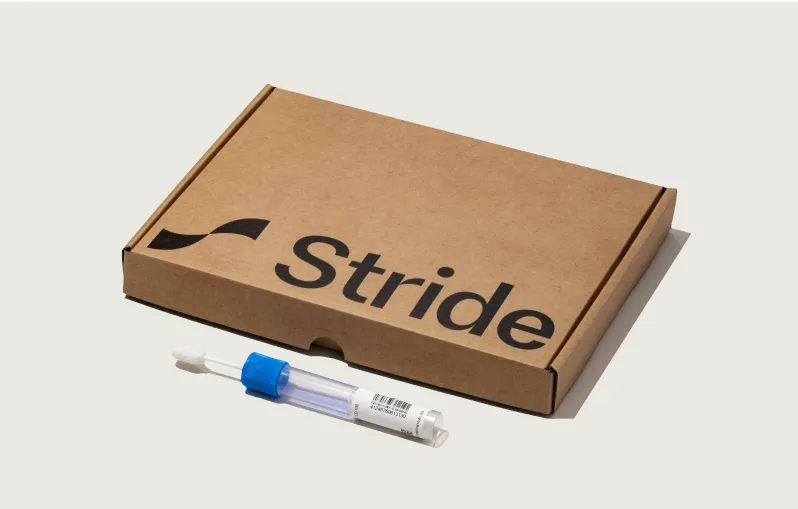







ApoB Blood Test (Apolipoprotein B)
ApoB is a heart health blood marker that measures the number of atherogenic ("artery-entering") cholesterol particles circulating in your bloodstream. Because each of these particles contains one ApoB molecule, ApoB acts as a direct particle count — helping reveal hidden cardiovascular risk that LDL cholesterol alone can miss.


Sample type
Blood sample

Collection
At-home

Often paired with
Lipid panel, triglycerides, non-HDL cholesterol, Lp(a), HbA1c, hs-CRP

Fasting required
Not always (follow your provider's guidance)
Key Benefits of Testing ApoB
- Pinpoint your burden of plaque-driving particles, beyond standard cholesterol numbers.
- Spot hidden risk when LDL looks normal, especially alongside higher triglycerides or insulin resistance.
- Clarify mixed results by measuring particle count, not just cholesterol concentration.
- Support clinician-guided decisions on treatment intensity and next steps.
- Track your response to lifestyle changes and lipid-lowering therapies with a stable marker.
- Help explain "residual risk" even when LDL cholesterol appears well controlled.
- Understand your cardiovascular risk as part of Stride's comprehensive approach — ApoB sits alongside 500+ biomarkers across your DNA, blood, and gut.
What Is Apolipoprotein B (ApoB)?
Apolipoprotein B (ApoB) is a structural protein found on the body's main cholesterol-carrying particles, including VLDL, IDL, LDL, and lipoprotein(a) [Lp(a)]. These particles are often referred to as atherogenic because they can enter artery walls and contribute to plaque formation.
Each atherogenic particle carries exactly one ApoB molecule, which is why ApoB is widely used as a practical way to estimate how many plaque-driving particles are circulating.
What Does ApoB Do?
ApoB packages, transports, and delivers hydrophobic lipids as stable, countable particles so the body can distribute energy and cholesterol safely through the bloodstream.
Blood is composed mostly of water. When you eat foods containing fat, these fats are broken down and enter the bloodstream as lipids — to be transported around the body for energy, hormone production, structural roles in nerves, and more. Because lipids are not soluble in water, they need to be packaged into safe transport vessels called lipoproteins. ApoB is the structural protein that makes this packaging possible.
Why Is ApoB Important for Heart Health?
ApoB is important because cardiovascular risk isn't only about how much cholesterol is in the blood — it's about how often artery walls are exposed to cholesterol-carrying particles over time.
ApoB helps quantify this exposure by estimating the number of particles capable of depositing cholesterol into vessel walls. Large epidemiologic studies and meta-analyses show that ApoB outperforms LDL cholesterol in predicting atherosclerotic cardiovascular disease risk, and that reducing ApoB is closely linked to fewer cardiovascular events over time.
ApoB vs LDL Cholesterol: What's the Difference?
It's easy to assume LDL cholesterol and ApoB mean the same thing — but they measure different parts of the story.
ApoB: Measures the number of atherogenic particles (LDL + VLDL + IDL + Lp(a))
LDL Cholesterol (LDL-C): Measures the amount of cholesterol inside LDL particles only
Non-HDL Cholesterol: Total cholesterol minus HDL (includes LDL + VLDL + IDL + Lp(a) by cholesterol mass)
Some people carry many small particles, where each particle holds less cholesterol. In that scenario, LDL-C may look "fine" while ApoB is elevated — meaning particle traffic is high and risk is higher than LDL-C suggests. ApoB is especially useful when triglycerides are elevated or insulin resistance is present, because particle number and cholesterol concentration may become "discordant."
Who Should Get an ApoB Test?
ApoB testing can be valuable for anyone who wants a more precise view of cardiovascular risk than standard cholesterol alone. It may be particularly relevant if you have:
- Elevated triglycerides or features of metabolic syndrome.
- Insulin resistance or type 2 diabetes.
- A family history of early heart disease or stroke.
- "Normal" LDL cholesterol but other metabolic risk factors.
- Established cardiovascular disease, to guide treatment targets.
- Statin or other lipid-lowering therapy, to check whether particle number has been adequately lowered.
Several expert groups, including the National Lipid Association and European societies, support ApoB as part of cardiovascular risk assessment in appropriate patients.
What Factors Affect ApoB Levels?
ApoB reflects how many cholesterol-carrying particles are in your blood. These are the main factors that influence that number:
- Genetics (baseline set point): Some people naturally produce more ApoB-containing particles than others, due to inherited variants affecting lipoprotein metabolism.
- Medications (strongest modifiable lever): Statins, PCSK9 inhibitors, ezetimibe, and some newer agents reduce ApoB. Certain drugs — including some hormones, retinoids, and immunosuppressants — can raise it.
- Body weight & metabolic health: Weight gain, especially around the abdomen, tends to raise ApoB, while weight loss usually lowers it. Fatty liver and poor metabolic health often push ApoB higher.
- Diet: Excess calories, refined carbohydrates, saturated fat, and alcohol can raise ApoB for many people. Whole-food, balanced diets with adequate fibre and unsaturated fats tend to support healthier levels, though responses vary person to person.
- Hormones: Thyroid function, sex hormones, menopause, pregnancy, and ageing all influence ApoB levels. ApoB often rises with age and after menopause.
- Physical activity: Regular exercise usually lowers ApoB modestly, with larger effects when it contributes to fat loss and improved insulin sensitivity.
- Alcohol: Low-to-moderate intake may have limited effect in some individuals, while higher intake often raises triglycerides and ApoB.
Can ApoB Be High with Normal LDL?
Yes, and it's more common than many people expect.
ApoB can be elevated while LDL cholesterol appears normal when there are many cholesterol particles circulating, but each carries a smaller amount of cholesterol. This pattern is frequently associated with:
- Elevated triglycerides.
- Insulin resistance and metabolic syndrome.
- Non-alcoholic fatty liver disease.
- Type 2 diabetes risk profiles.
This mismatch between ApoB and LDL-C is called LDL-C/ApoB discordance. Discordant patterns can signal higher cardiovascular risk than LDL-C alone would suggest, including in people treated with statins.
Normal vs Optimal ApoB: What's the Difference?
Most labs provide a general "reference range" for ApoB, but a reference range reflects typical population values — not necessarily the ideal level for prevention.
General population reference range: 60–120 mg/dL (0.6–1.2 g/L)
Desirable for lower-risk individuals: <90 mg/dL (<0.9 g/L)
Higher-risk (e.g. diabetes, metabolic syndrome): <80 mg/dL (<0.8 g/L)
Very high risk (established CVD): <65 mg/dL (<0.65 g/L)
European and North American guidelines generally recommend lower ApoB targets as overall cardiovascular risk increases. For cardiovascular protection, risk tends to decrease as ApoB moves toward the lower end of the range, because fewer particles mean less artery-wall exposure over a lifetime. Targets should always be individualised by a clinician.
With Stride, your ApoB result is interpreted alongside your wider cardiovascular, metabolic, and genetic markers — not in isolation.
ApoB Levels by Age
ApoB levels tend to increase gradually with age, and patterns differ between men and women across the life course. In premenopausal women, ApoB is often lower than in men of the same age, but this gap narrows after menopause as oestrogen levels decline.
Understanding your ApoB in the context of your age, sex, and metabolic health gives a more meaningful picture than comparing to a single population reference value.
Stride tests that include ApoB
FAQs
What is the ApoB blood test?
The ApoB blood test measures the number of atherogenic (artery-entering) cholesterol particles in your blood. Each particle carries one ApoB molecule, so the result acts as a direct particle count and a strong predictor of cardiovascular risk.
What is a normal ApoB level?
Most labs use a reference range of roughly 60–120 mg/dL (0.6–1.2 g/L), but "normal" simply reflects population averages rather than ideal prevention targets.
What is an optimal ApoB level for heart health?
Many expert groups suggest targets below 90 mg/dL for lower-risk individuals, below 80 mg/dL for higher-risk profiles such as diabetes, and below 65 mg/dL for people with established cardiovascular disease. Your clinician will individualise targets for you.
Is ApoB better than LDL cholesterol?
In many cases, yes. ApoB measures particle number, while LDL-C measures cholesterol content. Multiple studies show that particle number is often a better predictor of cardiovascular events, especially when triglycerides are elevated or metabolic syndrome is present.
Can ApoB be high with normal LDL?
Yes. This can happen when you have many smaller, cholesterol-depleted particles — often linked to higher triglycerides, insulin resistance, or metabolic syndrome. This LDL-C/ApoB discordance is associated with higher residual risk.
What causes high ApoB?
High ApoB can be driven by genetics, insulin resistance, metabolic syndrome, diabetes, excess calories and refined carbohydrates, high saturated fat intake, hypothyroidism, some medications, and higher alcohol consumption.
Is ApoB included in a standard cholesterol test?
No. Routine lipid panels do not include ApoB. It must be ordered specifically or obtained through services that measure it directly.
Do statins lower ApoB?
Yes. Statins typically reduce ApoB by around 25–45%, and other agents like PCSK9 inhibitors can lower it further. Measuring ApoB helps confirm that therapy is adequately lowering particle number.
Do I need to fast for ApoB?
Usually no. ApoB is relatively stable and not strongly affected by recent meals, though fasting may still be recommended if it is checked alongside a full lipid panel. Follow the instructions provided with your test.
How often should I test ApoB?
If your levels are optimal and stable, every 1–2 years may be sufficient. If you are changing lifestyle, starting new lipid-lowering treatment, or managing higher cardiovascular risk, 6–12‑monthly retesting can be helpful.
How can I lower ApoB? (clinician-guided)
ApoB can be lowered through improvements in metabolic health, targeted nutrition, physical activity, weight management, addressing secondary causes, and when appropriate, lipid-lowering medications guided by a clinician.