
Menu
-
Shop All
Contact
hey@getstride.com
Stride Health Group
Stride Health Group Ltd
Company No 05158025
Lamas Road
Badersfield
Norwich
England
NR10 5FB
UK
Extra 10% Off | Enter code GIFT at checkout


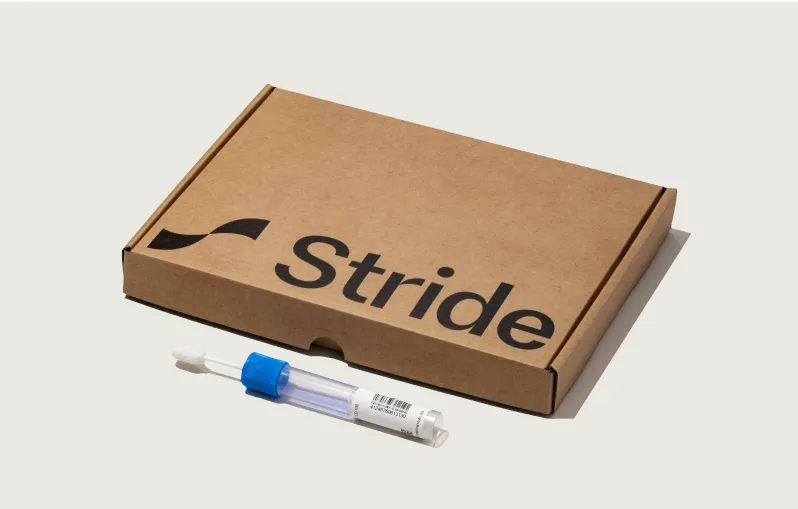






APOA2 Gene Test (Apolipoprotein A2)
The APOA2 gene test analyses DNA for variants in the apolipoprotein A2 gene that influence HDL composition, lipid metabolism, and how your body responds to saturated fat. Understanding your APOA2 status adds genetic context to obesity risk, HDL function, and cardiometabolic health so you can shape nutrition and lifestyle with more precision.


Sample type
Cheek swab, Blood sample

Collection
At-home

Often paired with
Full lipid profile (HDL, LDL, triglycerides, non-HDL), apolipoproteins, glucose and HbA1c, liver enzymes, high-sensitivity CRP, body composition and waist measurements, other lipid and obesity genes (APOA5, APOC3, FTO)

Fasting required
Not required
Key benefits of testing APOA2
- Identify whether you carry APOA2 promoter variants such as -265T>C (often tagged by rs5082) that interact strongly with saturated fat intake to influence BMI and obesity risk.
- Help explain why you may gain weight more easily or show less favourable lipid patterns on higher-saturated-fat diets compared with others eating similarly.
- Inform personalised nutrition strategies, including how tightly to moderate saturated fat, how to structure total fat and carbohydrate intake, and where to focus for HDL and waistline changes.
- Provide context for HDL function and anti-oxidant capacity, beyond simply measuring HDL cholesterol concentration.
- Clarify your baseline APOA2-driven response alongside lipids, body composition, and metabolic markers, so long-term weight, heart, and brain health plans can be built around your biology.
What is the APOA2 gene?
APOA2 encodes apolipoprotein A-II, the second most abundant protein in high-density lipoprotein particles after apolipoprotein A-I. ApoA-II is produced mainly in the liver and circulates on HDL as a monomer, homodimer, or heterodimer with apolipoprotein D.
ApoA-II helps regulate HDL structure, interactions with enzymes and lipid transfer proteins, and aspects of reverse cholesterol transport. Variants in APOA2 can lead to apolipoprotein A-II deficiency or contribute to hypercholesterolaemia in some contexts, and are also linked to body weight regulation through gene--diet interactions.
What does APOA2 do?
APOA2 sits at a key junction in HDL metabolism and lipid handling. ApoA-II influences HDL particle size, composition, and interaction with enzymes such as lipoprotein lipase, hepatic lipase, and lecithin--cholesterol acyltransferase, as well as with lipid transfer proteins that remodel HDL and other lipoproteins.
Through these interactions, apoA-II can modulate HDL's capacity to accept and transport cholesterol from peripheral tissues, its antioxidant and anti-inflammatory properties, and its role in triglyceride-rich lipoprotein metabolism. ApoA-II also appears to influence energy intake and body weight regulation, possibly through effects on satiety hormones such as ghrelin and on dietary fat handling.
Why is APOA2 important for health?
APOA2 contributes to three interconnected systems: HDL quality and function, body weight and obesity risk, and broader cardiometabolic health. While HDL cholesterol level has long been used as a marker of heart risk, the functional quality of HDL, including how well it supports reverse cholesterol transport and resists oxidation, is increasingly recognised as crucial.
ApoA-II can, in some settings, impair aspects of HDL's antioxidant function, while in others higher circulating APOA2 levels associate with lower cardiovascular risk. Promoter polymorphisms such as -265T>C show consistent interactions with saturated fat intake: individuals with the CC genotype have higher BMI and obesity risk when saturated fat intake is high, but not when it is low. This gene--diet interaction extends across multiple populations and suggests APOA2 plays a role in how saturated fat influences appetite, energy intake, and body composition.
APOA2 vs standard lipid tests and BMI
It is easy to assume that APOA2 testing, standard lipids, and BMI or body fat measures give the same information, but they speak to different layers of biology. APOA2 genotyping reveals your inherited pattern of apoA-II expression and its interaction with saturated fat, which helps set your responsiveness to certain diets and your HDL's likely functional profile.
Standard lipid panels show your current HDL, LDL, and triglyceride levels under your present diet, weight, and lifestyle, while BMI and waist measurements show how body composition has evolved over time. You can carry APOA2 risk genotypes yet maintain favourable lipids and body weight with appropriately structured diets, and you can have neutral genotypes yet develop obesity or dyslipidaemia if lifestyle stressors are high. Combining genotype with repeated lipids and anthropometrics creates a more nuanced, actionable picture.
What factors modify the effects of APOA2 variants?
The influence of APOA2 variants is shaped most strongly by diet, especially saturated fat intake, as well as by total energy balance, physical activity, and broader metabolic context. Several modifiable factors can either buffer genetic effects or amplify them.
- Saturated fat intake: The best-described interaction shows that APOA2 -265 CC homozygotes have higher BMI and obesity risk only when saturated fat intake is high. When saturated fat is kept lower, BMI and obesity risk are similar across genotypes.
- Total energy and macronutrient pattern: Energy surplus, high refined carbohydrate, and certain fat patterns combine with APOA2 risk genotypes to promote weight gain and adverse lipid changes. Balanced, whole-food patterns can neutralise much of this effect.
- Appetite and eating behaviour: APOA2 variants may influence satiety signalling and ghrelin levels, affecting portion sizes and snacking tendencies, particularly in high-saturated-fat environments. Deliberate structure around meals can help offset this.
- Physical activity and cardiorespiratory fitness: Regular movement and higher fitness support better lipid profiles, body composition, and energy balance, reducing the impact of APOA2-related susceptibility.
- Co-existing lipid and obesity genes: Variants in APOA5, APOC3, FTO, and other genes can compound or mitigate APOA2 effects, influencing how strongly diet and lifestyle changes show up in lipids and weight.
- Liver, thyroid, and glucose control: These systems shape HDL metabolism and weight regulation. Optimising them reduces the stress placed on APOA2-linked pathways.
Can you have APOA2 variants without symptoms?
Yes. Many people with APOA2 polymorphisms, including risk genotypes at -265T>C, do not have obvious symptoms or marked obesity, particularly if their saturated fat intake is modest and their lifestyle is supportive. The gene primarily modifies risk and responsiveness to diet, rather than causing inevitable disease.
Where APOA2 variants do contribute to problems, early manifestations often appear as gradual weight gain in a high-saturated-fat environment, subtle changes in HDL pattern, or slow drift in cardiometabolic markers, rather than sudden symptoms. Most of this risk is modifiable when identified early and addressed with targeted nutrition and lifestyle strategies.
APOA2 genotypes: how do common variants differ?
APOA2 genotypes mainly differ in how they influence apoA-II expression and, consequently, the interaction between saturated fat intake, BMI, and HDL behaviour. Understanding your pattern helps you decide how tightly to manage saturated fat and how much attention to pay to HDL quality.
- -265T>C (c.-492T>C) promoter polymorphism: CC homozygotes consistently show higher BMI and obesity risk on high-saturated-fat diets, but not when saturated fat is low. This genotype is also associated in some studies with changes in eating behaviour and ghrelin patterns.
- Other promoter and regulatory variants: Additional APOA2 regulatory SNPs may influence expression and lipid responses, though the -265T>C variant is the most widely studied for gene--diet interactions.
- Coding and structural variants: Rare coding changes can alter apoA-II structure and, in some contexts, contribute to lipid disorders such as familial hypercholesterolaemia or altered HDL subfractions.
- Combined gene--diet and gene--gene patterns: The overall picture emerges from APOA2 interacting with saturated fat intake, total diet quality, and other lipid-related genes, which is why multi-marker panels are helpful.
How do I prepare for an APOA2 test?
For DNA-based APOA2 testing, preparation is straightforward because your genotype does not change with recent diet, weight, or medications. The key step is deciding how you will use the information, for example to adjust saturated fat intake, structure a weight and lipid strategy, or fine-tune a cardiometabolic prevention plan.
Cheek swab, saliva, or blood-based APOA2 genotyping does not require fasting. If you are pairing genetic testing with fasting lipids, glucose, or other blood markers, follow the specific preparation guidance provided with those tests, which often includes overnight fasting and avoiding unusually intense exercise or alcohol just before the blood draw.
Do I need an APOA2 test?
An APOA2 test is most valuable when the result will change how you approach diet, weight management, and cardiometabolic prevention, rather than as a curiosity. It becomes particularly informative when combined with lipid panels, body composition data, and family history.
- Struggling with weight on higher-fat diets: If you gain weight easily on diets rich in saturated fat despite good adherence, APOA2 status can help explain why and support a better-matched approach.
- Borderline or adverse lipid trends: Subtle HDL, LDL, or triglyceride changes in the context of high-saturated-fat intake may be easier to interpret with APOA2 on the table.
- Family history of obesity or cardiovascular disease: In families with clustering of weight and heart issues, APOA2 testing can support earlier, tailored nutrition strategies for at-risk members.
- Comprehensive performance and longevity planning: For those using broad DNA and blood testing, APOA2 sits alongside APOA5, APOC3, and other lipid genes as a key lever for aligning diet with long-term cardiometabolic goals.
Stride tests that include APOA2


Health Tests
Core DNA Methylation Test
5 reports: Methylation profile reports
From $229 $183.20
FAQs
What is the APOA2 gene test?
The APOA2 gene test analyses your DNA from blood or saliva to look for variants in the apolipoprotein A2 gene that influence HDL composition, lipid metabolism, and how your body responds to saturated fat in terms of weight and cardiometabolic risk.
What does an APOA2 variant mean?
Promoter variants such as -265T>C can increase BMI and obesity risk when saturated fat intake is high but have little effect when saturated fat is low. Other variants can subtly modify HDL behaviour and lipid patterns.
Do APOA2 variants always cause obesity or high cholesterol?
No. APOA2 variants shift your sensitivity to saturated fat and HDL behaviour, but actual outcomes depend heavily on diet, total energy intake, body composition, movement, and other genes. Risk variants can often be neutralised with appropriately structured habits.
Is APOA2 testing used to diagnose heart disease?
APOA2 testing is not a diagnostic tool for heart disease, but it adds useful context when designing personalised nutrition and lifestyle strategies for weight and lipid management, especially alongside lipid panels and other risk markers.
Do I need an APOA2 test?
You might consider an APOA2 test if you gain weight easily on higher-fat diets, have borderline or shifting lipid profiles, a family history of obesity or heart disease, or if you are building a detailed prevention and performance plan where saturated fat response and HDL function matter.
Do I need to fast for APOA2 testing?
Fasting is not required for DNA-based APOA2 testing. If fasting lipids or other blood tests are performed at the same time, follow the preparation guidance for those tests.
How can I optimise my health if I carry APOA2 risk variants?
Rather than trying to change the gene, focus on moderating saturated fat intake, basing your diet on whole foods and balanced macronutrients, maintaining or moving toward a healthy body composition, moving regularly, limiting ultra-processed foods and added sugars, supporting liver and metabolic health, and tracking lipids and waist measurements over time so you can see how consistent, targeted changes reshape your long-term risk and performance.